Fresh thinking for
growing businesses.
Ideas, practical guides and lessons from building brands, connecting systems and putting AI to work.
AI
AI Deploy: A Strategic Guide for 2026
· 4 min read
Artificial intelligence has moved from experimental technology to mission-critical infrastructure. Yet most organizations struggle with the gap between purchasing AI tools and successfully deploying them into production environments. The term "ai deploy" encompasses far more than flipping a switch on a new feature. It represents a comprehensive process of assessment, configuration, integration, testing, and continuous optimization that determines whether AI delivers measurable business value or becomes another underutilized technology investment gathering digital dust.
Understanding What AI Deploy Actually Means
AI deployment is the systematic process of taking artificial intelligence models, agents, or capabilities from development or pilot phases into live production environments where they interact with real business data and workflows. This process requires technical implementation, organizational change management, and ongoing performance monitoring.
When businesses discuss how to ai deploy solutions effectively, they're addressing several interconnected challenges. First, they must identify which processes genuinely benefit from automation versus those requiring human judgment. Second, they need clean, structured data that AI systems can reliably process. Third, they require integration architecture that connects AI tools with existing systems without creating data silos or workflow bottlenecks.
The Technical Foundation
Modern AI deployment typically involves one of three approaches: native platform features, third-party specialized tools, or custom-built solutions. Each carries distinct advantages and implementation requirements.
Native platform AI (like HubSpot Breeze agents) offers the fastest deployment path because it's pre-integrated with your existing data model. These solutions understand your contact records, deal properties, and workflow structure without requiring API connections or middleware. The tradeoff is limited customization compared to purpose-built tools.
Third-party AI tools provide specialized capabilities for specific use cases like conversational intelligence, content generation, or predictive lead scoring. These require API connections and data mapping but offer deeper functionality in their domain. Successful deployment demands careful attention to data quality and structure since these tools depend on consistent, clean inputs.
Custom AI solutions built on frameworks like TensorFlow or PyTorch offer maximum flexibility but require data science expertise and significant ongoing maintenance. Most mid-market businesses find this approach cost-prohibitive compared to configured platform solutions.

Pre-Deployment Assessment Framework
Before any technical work begins, successful ai deploy projects start with structured discovery that maps business processes to AI capabilities. This assessment prevents the common mistake of implementing AI for technology's sake rather than solving actual business problems.
Identifying High-Value Use Cases
Start by cataloging repetitive, rules-based tasks that consume significant staff time. These represent the clearest opportunities for AI augmentation. Common examples include:
Lead qualification and routing based on demographic and behavioral signals
Email response drafting for common customer service inquiries
Data enrichment to populate missing contact or company information
Meeting summarization and action item extraction
Content personalization based on segment characteristics
Score each use case on three dimensions: time savings potential, implementation complexity, and impact on revenue operations. Focus first on high-impact, moderate-complexity opportunities rather than attempting to deploy AI across every possible use case simultaneously.
Data Readiness Assessment
AI systems require structured, consistent data to function reliably. A pre-deployment audit should examine:
Completeness: What percentage of critical fields contain usable data?
Consistency: Are values standardized or do they vary (e.g., "New York," "NY," "new york")?
Accuracy: When was data last validated against source-of-truth systems?
Accessibility: Can AI tools reach the data through APIs or integrations?
Data Quality Dimension | Minimum Threshold | Assessment Method |
|---|---|---|
Field Completeness | 80% for critical properties | Database query analysis |
Format Consistency | 95% adherence to standards | Pattern matching audit |
Record Accuracy | 90% match to validated sources | Sample verification |
Integration Access | Full API coverage | Technical documentation review |
Many organizations discover their data requires significant cleanup before ai deploy projects can proceed. This discovery, while sometimes frustrating, prevents downstream failures where AI makes decisions based on incomplete or inaccurate information.
Technical Implementation Process
Once assessment confirms organizational readiness, the technical implementation follows a structured deployment pathway. This process minimizes disruption while building confidence in AI system performance.
Configuration and Integration Setup
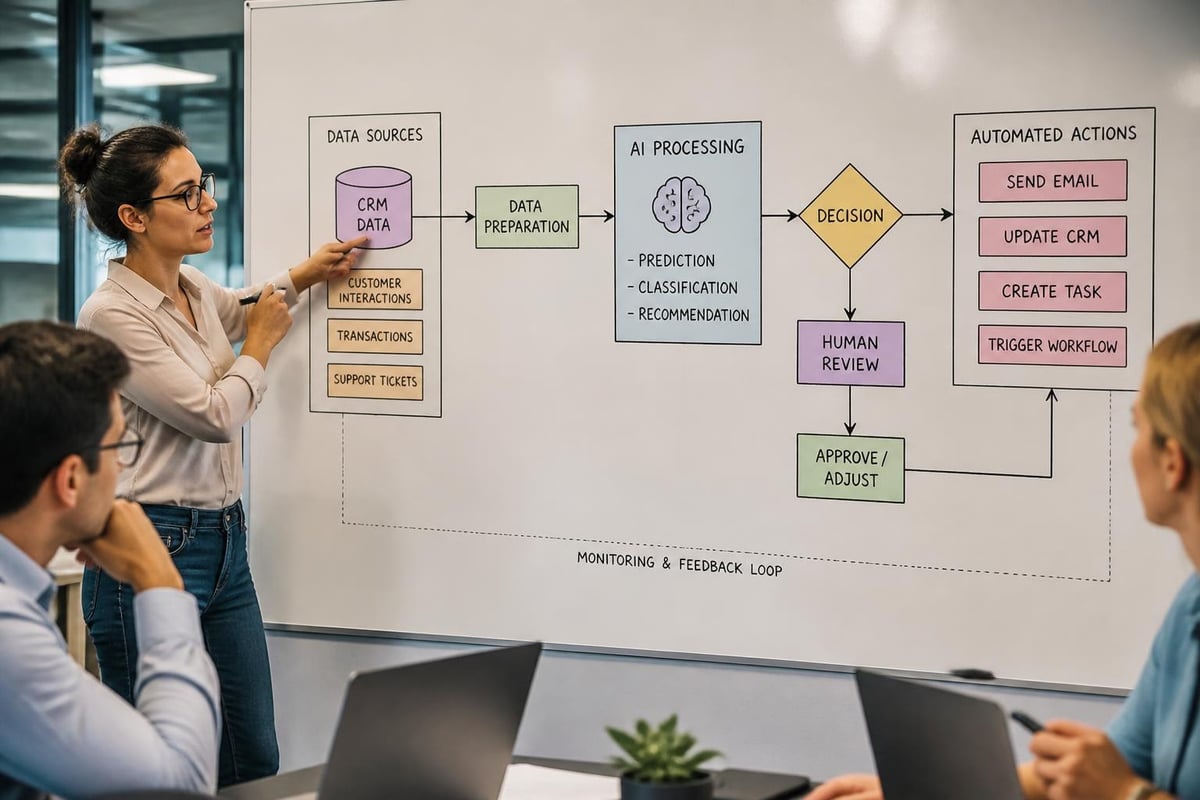
The first technical phase establishes connections between AI tools and your operational systems. For CRM-based deployments, this means configuring access to contact databases, deal pipelines, and activity histories.
Authentication and permissions come first. AI agents need appropriate read and write access to function, but over-permissioning creates security risks. Grant access incrementally, starting with read-only capabilities during testing phases.
Data mapping translates your business terminology into formats AI systems understand. When you ai deploy lead scoring models, for example, the system needs to know which fields represent engagement signals, firmographic data, and behavioral indicators. Incorrect mapping produces unreliable outputs regardless of how sophisticated the underlying AI model might be.
Workflow integration connects AI outputs to downstream processes. A lead scoring system that doesn't automatically route high-value prospects to sales creates no practical value. Integration work often consumes more time than the core AI configuration because it touches multiple systems and business processes.
Testing and Validation Protocols
Never deploy AI directly into production workflows without structured testing. Create parallel environments where AI systems process real data but don't trigger actual business actions until validation confirms acceptable performance.
Shadow mode testing runs AI alongside human operators, logging what the AI would have done without actually executing those actions. This reveals decision patterns and edge cases before AI assumes control of live processes. For instance, when testing AI-powered lead routing, track which sales reps would have received each lead and compare AI assignments to your manual routing logic.
Threshold calibration adjusts sensitivity settings to match your business tolerance for false positives versus false negatives. An AI chatbot that escalates too frequently wastes human time; one that escalates too rarely frustrates customers. Finding the right balance requires testing with production data volumes and complexity.
The AI Implementation (HubSpot Breeze + AI Tooling) service approach emphasizes this validation phase because poorly calibrated AI creates more problems than it solves. Teams often underestimate how much testing is required to achieve reliable performance across diverse scenarios.
Deployment Rollout Strategies
How you introduce AI capabilities to users significantly impacts adoption rates and overall project success. Gradual rollouts outperform "big bang" deployments across nearly every organizational context.
Phased Rollout Approach
Start with a single department, process, or use case rather than attempting organization-wide deployment. This contained scope allows you to:
Build expertise within a core team who become internal champions
Identify and resolve issues before they affect the entire organization
Demonstrate concrete results that build confidence for broader rollout
Refine training materials based on actual user questions and challenges
Week 1-2: Deploy to a pilot group of 5-10 power users who understand the process intimately and can provide detailed feedback.
Week 3-4: Expand to the full first department or team (typically 20-50 users) while maintaining close monitoring and support.
Week 5-8: Based on performance data and user feedback, refine configurations and expand to additional teams or use cases.
This timeline assumes moderate complexity. Simple ai deploy projects like automated meeting summaries might compress to 2-3 weeks total, while complex implementations involving multiple AI agents and intricate workflows may require 12-16 weeks for full organizational rollout.
Change Management Considerations
Technical deployment represents only half the challenge. User adoption determines whether AI delivers promised value. Effective change management addresses several common resistance patterns:
Fear of replacement: Many employees worry AI will eliminate their roles. Frame AI as augmentation that handles repetitive tasks so humans can focus on relationship-building, complex problem-solving, and strategic work. Share specific examples of how time savings will be reallocated to higher-value activities.
Skepticism about accuracy: Early AI mistakes create lasting credibility problems. Set realistic expectations about AI capabilities and limitations. Explain that AI handles probabilistic tasks and improves over time through feedback, rather than positioning it as infallible.
Training and support: Don't assume users will intuitively understand how to work alongside AI systems. Provide hands-on training that covers not just mechanics but decision-making about when to trust AI outputs versus when to override them.
Monitoring and Optimization Post-Deployment
Launching AI into production marks the beginning of ongoing optimization rather than project completion. Continuous monitoring ensures AI systems adapt as business conditions, data patterns, and operational requirements evolve.
Performance Metrics That Matter
Track metrics that connect AI functionality to business outcomes rather than just technical performance indicators. While model accuracy matters, business leaders care more about whether AI deployment improves efficiency, revenue, or customer satisfaction.
AI Use Case | Technical Metric | Business Metric |
|---|---|---|
Lead Scoring | Prediction accuracy rate | Conversion rate of AI-qualified leads |
Email Response | Grammar/tone consistency | First response time reduction |
Data Enrichment | Field completion percentage | Sales cycle length reduction |
Content Generation | Output volume | Engagement rate on AI-assisted content |
Monitor both sets of metrics. Declining technical performance often predicts future business impact problems, while business metrics validate that AI delivers practical value despite any technical imperfections.
Feedback Loops and Continuous Improvement
Create structured processes for users to report issues, suggest improvements, and flag situations where AI performed unexpectedly. These feedback mechanisms serve two purposes: they identify technical problems requiring fixes, and they reveal opportunities to expand AI applications to additional use cases.
Weekly review sessions during the first month post-deployment help catch issues quickly. Review dashboards showing AI decision patterns, user override rates, and error flags. High override rates in specific scenarios indicate either poor AI training for those conditions or unclear user guidance about when to trust AI outputs.
Monthly optimization sprints adjust AI configurations based on accumulated performance data. You might refine lead scoring weights as you identify which signals most reliably predict conversion, or adjust chatbot escalation rules based on customer satisfaction scores.
The pipeline reporting infrastructure many organizations already use for revenue operations provides an excellent foundation for monitoring AI performance since it captures outcome data that validates AI effectiveness.

Integration With Existing RevOps Infrastructure
AI deployment doesn't occur in isolation. It must integrate with established revenue operations processes, reporting structures, and technology stacks. Organizations with mature RevOps foundations typically achieve faster, more successful ai deploy outcomes than those attempting to build infrastructure and implement AI simultaneously.
CRM as the AI Foundation
Modern CRM platforms serve as the central nervous system for AI deployment in revenue operations. Contact data, interaction histories, deal progression, and engagement signals all flow through the CRM, making it the logical hub for AI agents that need comprehensive business context.
When evaluating where to ai deploy capabilities first, prioritize use cases that leverage existing CRM data rather than requiring new data collection processes. AI that enhances CRM implementation you've already invested in creates compounding value.
Data Architecture Considerations
AI systems amplify both the benefits of clean data and the problems of dirty data. Before deployment, audit your data architecture for:
Property standardization: Ensure fields AI will reference use consistent formats and naming conventions across objects. When contact properties, company properties, and deal properties reference the same concepts using different names or structures, AI struggles to make reliable connections.
Historical data quality: AI trained on historical patterns inherits any biases or errors in that training data. If your CRM contains years of inconsistently entered information, clean critical fields before ai deploy projects or risk perpetuating and automating historical mistakes.
Integration reliability: AI that depends on data synced from external systems fails when those integrations break. Establish monitoring for integration health and data freshness so AI doesn't make decisions based on stale information.
Organizations that invested in data quality for AI before deployment report significantly smoother implementations and faster time-to-value compared to those attempting to clean data and deploy AI concurrently.
Common Deployment Challenges and Solutions
Even well-planned ai deploy projects encounter obstacles. Understanding common failure patterns helps you anticipate and mitigate these risks before they derail implementation timelines or erode user confidence.
Challenge: Insufficient User Adoption
Symptom: AI tools are configured and available, but usage remains low or users quickly revert to manual processes.
Root causes: Inadequate training, unclear value proposition, or AI that creates more work than it saves due to poor configuration.
Solutions: Conduct user interviews to understand adoption barriers. Often, minor workflow adjustments dramatically improve usability. Make AI the path of least resistance rather than an optional feature users can ignore. Build AI capabilities directly into existing workflows rather than requiring users to visit separate interfaces.
Challenge: Unexpected AI Outputs
Symptom: AI makes decisions or generates content that doesn't align with business logic or brand standards.
Root causes: Incomplete configuration, training data that doesn't represent current business conditions, or edge cases not covered in testing.
Solutions: Implement guardrails that flag unusual AI outputs for human review before execution. Create feedback mechanisms where users can easily report problematic AI behavior with context about what went wrong. Use these reports to refine AI training and expand testing scenarios.
Challenge: Integration Failures
Symptom: AI systems lose access to data, trigger duplicate actions, or fail to execute intended automations.
Root causes: API rate limits, authentication expiration, data format mismatches, or dependency on deprecated system features.
Solutions: Build comprehensive error handling that logs failures with sufficient detail for troubleshooting. Establish monitoring alerts for integration health. When you ai deploy solutions dependent on multiple system connections, assume at least one will fail occasionally and design graceful degradation paths.
Security and Compliance in AI Deployment
AI systems that process customer data, financial information, or proprietary business intelligence require careful security and compliance consideration. Deployment shortcuts that compromise data protection create legal and reputational risks that far exceed any efficiency gains.
Data Privacy Considerations
Different AI deployment models create different data exposure profiles. Native platform AI (like HubSpot Breeze) typically keeps data within your existing environment and processes it according to your platform's data processing agreement. Third-party AI tools often send data to external servers for processing, requiring careful review of vendor security practices and data handling policies.
Key questions before deployment:
Where is data processed and stored geographically?
Does the AI vendor use customer data to train models for other customers?
What data retention and deletion capabilities exist?
How is data encrypted in transit and at rest?
What compliance certifications does the vendor maintain (SOC 2, GDPR, HIPAA)?
Access Control and Audit Trails
AI agents operating with system-level access can modify records, send communications, or trigger workflows across your entire database. Implement principle of least privilege by granting AI only the minimum permissions required for its intended function.
Maintain comprehensive audit trails showing what actions AI systems took, when, and based on what inputs. This logging serves multiple purposes: troubleshooting when AI produces unexpected results, compliance demonstration during audits, and security investigation if AI access is compromised.
Building Internal AI Expertise
Long-term ai deploy success requires developing organizational capabilities rather than depending entirely on external vendors. While partners provide essential expertise during initial implementation, internal teams need sufficient knowledge to manage, troubleshoot, and optimize AI systems independently.
Training Team Members
Different roles require different levels of AI literacy. Sales representatives using AI-generated email drafts need basic understanding of how to review and refine outputs. Revenue operations teams managing AI configurations need deeper technical knowledge about training data, performance metrics, and integration architecture.
Create tiered training programs:
End user training (1-2 hours): Covers practical usage, when to trust AI versus human judgment, and how to report issues.
Power user training (half day): Includes basic configuration, performance monitoring, and first-level troubleshooting for team leads and department admins.
Administrator training (1-2 days): Comprehensive technical training on architecture, integration management, and advanced optimization for RevOps team members who maintain AI systems.
Documentation and Knowledge Transfer
Document not just how AI is configured but why specific decisions were made. Future team members inheriting AI systems need context about business logic encoded in configurations, known limitations or edge cases, and the evolution of AI capabilities over time.
Maintaining clear documentation proves especially critical for organizations working with implementation partners. Even excellent partner work creates dependency risks if all knowledge resides with external consultants rather than being transferred to internal teams through structured training programs.
Scaling AI Across the Organization
Once initial ai deploy projects demonstrate value, organizations naturally consider expanding AI to additional use cases and departments. This scaling phase introduces new challenges around governance, resource allocation, and maintaining consistency across multiple AI implementations.
Governance Frameworks
As AI deployment expands beyond a single team or use case, establish governance structures that balance innovation with control. Without governance, organizations end up with fragmented AI implementations that don't share learnings, duplicate efforts, or worse, work at cross-purposes.
AI steering committee: Representatives from IT, RevOps, affected business units, and leadership review AI proposals, prioritize deployments, and ensure alignment with strategic objectives.
Standards and best practices: Document approved AI vendors, security requirements, testing protocols, and performance benchmarks so individual teams don't make inconsistent decisions that create support complexity.
Resource allocation: AI deployment requires time from technical teams, business stakeholders, and end users. Centralized governance prevents over-commitment where teams attempt more AI projects than available resources support.
Measuring ROI Across Multiple AI Deployments
Individual AI use cases may show clear ROI, but organizations need frameworks for comparing different ai deploy opportunities and making portfolio-level investment decisions. Consider both quantitative and qualitative factors:
Quantitative ROI metrics:
Time savings (hours per week multiplied by hourly labor cost)
Revenue impact (increased conversion rates, faster sales cycles, higher average deal size)
Cost avoidance (headcount that doesn't need to be added due to AI efficiency gains)
Qualitative strategic value:
Competitive differentiation from AI-powered capabilities
Employee satisfaction improvements from automating frustrating tasks
Customer experience enhancements from faster, more personalized service
Organizations achieving the greatest value from AI view deployment as ongoing strategic capability-building rather than discrete technology projects. They continuously evaluate new AI opportunities, retire deployments that don't deliver expected value, and optimize existing implementations based on evolving business needs.
Successfully implementing AI requires more than just activating features or subscribing to tools. It demands strategic assessment, careful technical integration, user-centered change management, and continuous optimization. Organizations that approach ai deploy systematically, with attention to data quality, workflow integration, and measured rollout, achieve meaningful operational improvements while those rushing implementation often struggle with adoption and reliability. Revio helps businesses navigate this complexity by implementing AI inside HubSpot and integrating best-in-class tools where native features don't meet specific needs, ensuring AI deployments deliver measurable time savings rather than becoming unused technology investments.
Put good ideas to work in your business.
We build practical AI systems around your customers, your team and the work that helps your business grow.