CRM
CRM Solutions: A Strategic Guide for Growth in 2026
· 15 min read
Customer relationship management has evolved far beyond simple contact databases. Today's CRM solutions serve as the operational backbone for revenue-generating teams, orchestrating everything from initial prospect engagement through post-sale support and renewal. For businesses serious about sustainable growth in 2026, selecting and implementing the right CRM solutions represents one of the most consequential technology decisions leadership will make. The difference between systems that enable growth and those that create bottlenecks often comes down to strategic implementation, thoughtful configuration, and alignment with actual business processes rather than theoretical best practices.
Understanding Modern CRM Solutions Architecture
CRM solutions in 2026 function as integrated platforms rather than standalone tools. The architecture encompasses data management, workflow automation, communication tracking, reporting infrastructure, and increasingly, artificial intelligence capabilities that enhance decision-making and operational efficiency.
Core Components Every Business Needs
The foundation of effective CRM solutions includes several critical elements that work in concert. Contact and company management provides the structural database where customer information lives, but modern systems go well beyond name and email storage. Pipeline and deal tracking visualizes revenue opportunities through stages, enabling forecasting and resource allocation. Activity logging captures every customer interaction across email, phone, meetings, and digital touchpoints, creating comprehensive engagement histories.
Automation workflows eliminate manual, repetitive tasks while ensuring consistent follow-up and data hygiene. These systems trigger actions based on specific conditions, from lead assignment rules to renewal reminders. Reporting and analytics transform raw activity data into actionable insights about pipeline health, conversion rates, and revenue performance.
Modern CRM solutions increasingly incorporate AI agents that handle data enrichment, lead scoring, content generation, and predictive analytics. According to IDC research on agentic AI in CRM, organizations are moving toward systems where intelligent automation handles routine decisions while surfacing exceptions that require human judgment.
Selecting CRM Solutions That Match Business Reality
The CRM marketplace presents hundreds of options, each promising to revolutionize how businesses manage customer relationships. Cutting through marketing noise requires focusing on specific criteria aligned with organizational needs rather than feature checklists.
Scalability determines whether the platform can grow alongside the business without requiring a costly migration in two years. Consider both data volume capacity and functional expansion as teams add users, processes become more sophisticated, and integration requirements multiply.
Ease of adoption directly impacts ROI, yet many organizations overlook this factor until they face user resistance post-implementation. Systems that align with how teams already work, require minimal training, and deliver immediate value see significantly higher adoption rates than those requiring extensive behavioral change.
Integration capabilities have become non-negotiable for businesses running modern technology stacks. CRM solutions must connect bidirectionally with marketing automation, customer support platforms, accounting systems, project management tools, and industry-specific applications. Native integrations provide the most reliable connections, while API access enables custom workflows when needed.
Selection Criterion | Questions to Ask | Red Flags |
|---|---|---|
Data model flexibility | Can we customize objects, properties, and relationships? | Rigid schema that doesn't match our sales process |
Reporting depth | Can we build custom reports and dashboards? | Pre-built reports only; limited filtering options |
Automation power | What triggers, conditions, and actions are available? | Basic email sequences without branching logic |
Mobile experience | Do field teams have full functionality on mobile? | Read-only mobile access; clunky interface |
Support structure | What implementation help and ongoing support is included? | Self-service only; long response times |
Evaluating Vendor Stability and Ecosystem
Beyond feature comparison, vendor evaluation should examine financial stability, product roadmap transparency, and ecosystem health. Platforms with robust partner networks, active developer communities, and regular innovation cycles indicate long-term viability.
The Forrester Wave evaluation framework for CRM software provides structured methodology for assessing vendors across current offering, strategy, and market presence dimensions. While Forrester evaluations focus on enterprise scenarios, the assessment criteria apply equally to mid-market decisions.
Consider total cost of ownership beyond license fees. Implementation costs, ongoing administration requirements, training needs, integration development, and customization expenses often exceed the annual subscription by multiples.
Implementation Strategy for CRM Solutions
Even the most powerful CRM solutions fail when implementation prioritizes speed over strategic foundation. Successful deployments follow deliberate processes that align system configuration with business workflows rather than forcing teams to adapt to generic templates.
Pre-Implementation Planning Phase
Before configuring a single field, document current processes with brutal honesty. Map how leads currently enter the business, tracking every handoff point, qualification step, and decision gate through the revenue cycle. Identify pain points in existing workflows where information gets lost, follow-up falls through cracks, or reporting requires manual data compilation.
Define your data model by determining what objects the business needs (contacts, companies, deals, projects, products), what properties each object requires, and how these entities relate to one another. This foundational work prevents the downstream chaos of restructuring populated databases.
Establish governance policies covering data entry standards, duplicate management protocols, required fields at each lifecycle stage, and assignment rules. Teams implementing clean data practices from day one avoid the expensive remediation projects that plague organizations six months into CRM usage.
Configuration and Migration Execution
Build your staging environment with the complete data model, custom properties, pipeline stages, and lifecycle definitions before importing records
Configure automation workflows that enforce data standards, trigger appropriate follow-ups, and route records to the right teams based on defined criteria
Design reporting dashboards that answer specific business questions rather than displaying vanity metrics
Test thoroughly with sample data representing edge cases and complex scenarios before touching production records
Execute data migration in phases, validating each batch before proceeding, with particular attention to relationship mappings and historical activity preservation
For businesses switching from legacy systems, partnering with specialists who understand both technical migration mechanics and business process translation can prevent the data quality disasters and adoption failures that derail CRM projects. Expert-led implementation ensures configurations match actual workflows rather than creating technical debt.
Maximizing Value Through CRM Solutions Optimization
Initial implementation represents the beginning of CRM value realization rather than the endpoint. Organizations that treat their CRM solutions as living systems requiring ongoing refinement extract significantly more value than those operating on a "set and forget" mentality.
Automation Opportunities That Drive Efficiency
Pipeline automation eliminates manual tasks that drain productivity while ensuring consistent execution of business processes. Lead routing automatically assigns new prospects to appropriate sales representatives based on territory, product interest, company size, or round-robin distribution. Deal progression workflows trigger stage-specific tasks, update probability forecasts, and alert managers when opportunities stall.
Data enrichment automation pulls information from third-party sources to complete contact profiles, append firmographic details, and maintain current employment records without manual research. Follow-up sequences ensure no prospect falls through cracks by scheduling reminder tasks, sending templated outreach at prescribed intervals, and escalating to managers when responses lag.
Modern platforms enable sophisticated automation logic with conditional branching, wait periods, enrollment triggers, and suppression lists. Teams implementing AI-driven automation increasingly delegate routine decision-making to machine learning models while focusing human attention on high-value interactions requiring judgment.
Revenue Reporting Infrastructure
CRM solutions provide the single source of truth for pipeline health, sales performance, and revenue forecasting when configured properly. Effective reporting architecture requires thoughtful design around specific business questions rather than generic dashboard templates.
Pipeline velocity metrics track how quickly opportunities move through stages, identifying bottlenecks where deals stall and coaching opportunities where conversion rates lag. Win/loss analysis correlates closed outcomes with deal characteristics, competitive situations, and sales activities to inform strategy adjustments.
Attribution reporting connects revenue outcomes back to originating marketing campaigns, referral sources, and touchpoint sequences. This visibility enables resource allocation decisions based on actual ROI rather than assumptions about what drives customer acquisition.
Monthly recurring revenue (MRR) trends and churn analysis
Sales activity metrics tied to individual and team quotas
Forecast accuracy comparing predicted close dates against actuals
Customer lifetime value segmentation informing retention priorities
Organizations struggling with revenue reporting accuracy often face data quality issues, inconsistent stage definitions, or missing integration points rather than platform limitations.
Integration Patterns for CRM Solutions
Isolated CRM solutions create information silos that force teams into manual data synchronization and context switching between platforms. Strategic integration architecture ensures customer data flows bidirectionally across the technology stack while maintaining a single source of truth.
Common Integration Scenarios
Marketing automation platforms sync lead scoring, campaign engagement, and content interaction data into the CRM while pulling contact updates and sales feedback back to inform nurture programs. Proper integration eliminates the sales and marketing disconnect where opportunities fall between systems.
Customer support systems surface ticket history, product issues, and satisfaction scores within CRM contact records, giving sales teams complete context during renewal conversations. Support teams gain visibility into account value and strategic importance when prioritizing issue resolution.
Accounting and invoicing tools connect billing data, payment history, and financial health indicators to customer records. This integration enables sales teams to identify upsell opportunities, avoid pitching unprofitable accounts, and coordinate with finance on collection issues.
Project management platforms link delivery progress, resource allocation, and milestone completion to customer records, particularly valuable for services businesses where post-sale execution impacts retention and referrals.
AWS integration patterns for SaaS applications provide architectural guidance for implementing secure, scalable connections between cloud platforms using API gateways, event-driven architectures, and data synchronization strategies.
Integration Type | Business Value | Technical Approach |
|---|---|---|
Marketing automation | Unified lead scoring and nurture coordination | Native connector or iPaaS middleware |
E-commerce platform | Purchase history and customer lifetime value | Webhook-triggered API sync |
Customer support | Complete interaction history and satisfaction data | Bidirectional record association |
Calendar and email | Automatic activity logging and meeting scheduling | OAuth-based native integration |
Custom line-of-business apps | Industry-specific data and workflow automation | API development or integration platform |
Organizations with complex integration requirements benefit from specialized expertise that understands both technical implementation and business process implications. Poor integration design creates data conflicts, duplication, and synchronization failures that undermine trust in the entire system.
Privacy, Security, and Compliance Considerations
CRM solutions house sensitive customer information subject to increasingly stringent regulatory requirements. Organizations operating across jurisdictions must implement technical controls and governance policies that protect data while enabling legitimate business use.
Data Protection Requirements
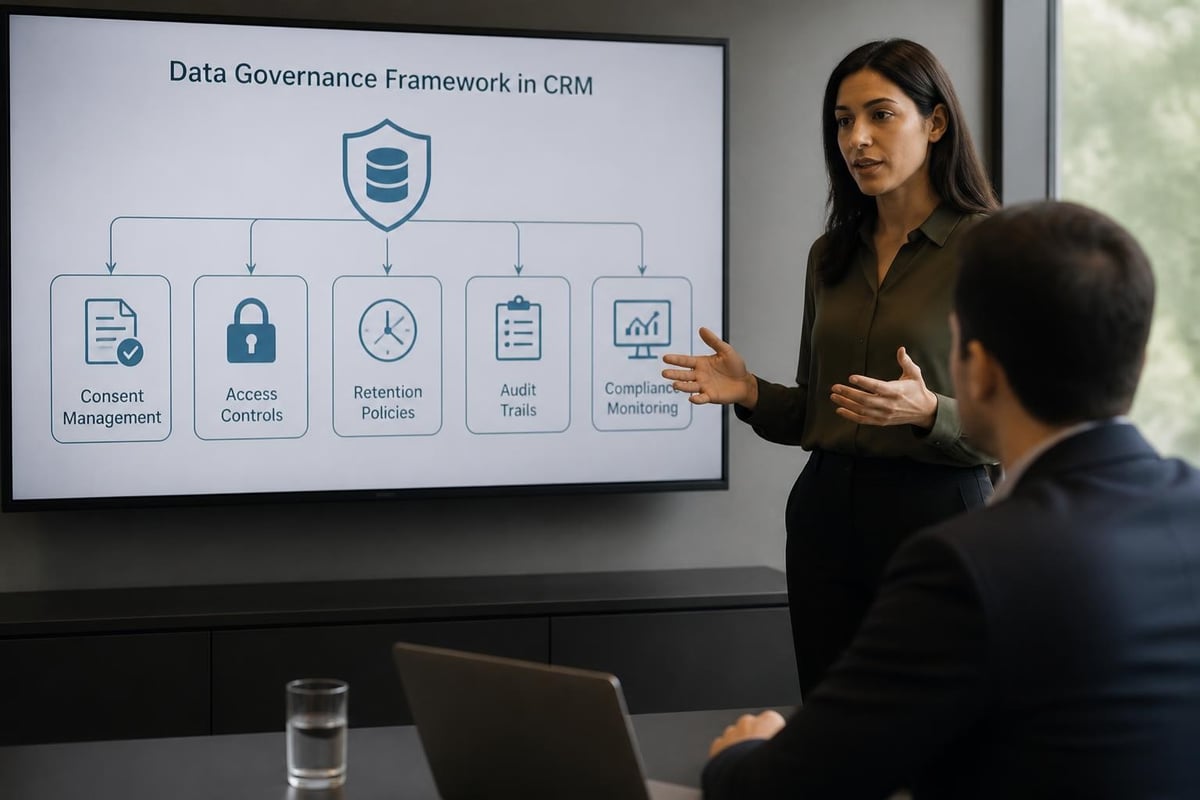
GDPR, CCPA, and evolving privacy regulations mandate specific capabilities within CRM solutions. Consent management tracks the legal basis for processing each contact's information, recording opt-ins, opt-outs, and preference updates with timestamps and source attribution. Right to access requests require systems that can efficiently locate and export all data associated with specific individuals across integrated platforms.
Data minimization principles encourage collecting only information necessary for defined business purposes and establishing retention policies that automatically purge outdated records. Access controls ensure employees view only data relevant to their roles, with audit logs tracking who accessed which records and when.
The NIST Privacy Framework provides structured guidance for identifying privacy risks, implementing protective controls, and establishing governance processes. Organizations handling customer data should map CRM configurations against this framework to identify gaps.
UK ICO guidance on CRM and customer data offers practical perspective on lawful processing, transparency requirements, and individual rights within CRM contexts. Compliance isn't merely a legal checkbox but builds customer trust that differentiates businesses in privacy-conscious markets.
Avoiding Common CRM Solutions Implementation Failures
Despite massive investment in CRM technology, failure rates remain stubbornly high. Harvard Business Review's analysis of CRM perils identified strategic misalignment, inadequate change management, poor data quality, and unrealistic expectations as primary culprits behind failed implementations.
Strategic Misalignment Between System and Business Model
The first peril occurs when organizations implement CRM solutions designed for different business models. A platform optimized for transactional B2C sales creates friction for complex B2B enterprises with multi-stakeholder buying committees and year-long sales cycles. Conversely, enterprise-focused systems overwhelm small businesses with unnecessary complexity.
Before committing to platforms, validate that the underlying data model, pipeline structure, and workflow capabilities match how the business actually operates. Customization can bridge small gaps but cannot fundamentally reshape systems designed for different contexts.
User Adoption Resistance
Technology alone never drives CRM success. Teams must actually use the system consistently and accurately for it to deliver value. Adoption failures stem from poor training, lack of leadership buy-in, insufficient "what's in it for me" messaging, and systems that create more work than they eliminate.
Executive sponsorship proves critical for driving adoption. When leadership visibly uses the CRM for decision-making and holds teams accountable to data standards, adoption rates soar. Conversely, executives demanding reports while ignoring the system themselves guarantee failure.
Progressive rollout builds adoption momentum by delivering quick wins before tackling complex features. Start with basic contact management and activity logging, demonstrate immediate value through simple reports, then layer in automation and advanced functionality as confidence builds.
Configure the system to match existing workflows rather than forcing process changes during initial rollout
Invest in role-specific training that shows each team how CRM makes their job easier
Celebrate early adopters and share success stories across the organization
Establish clear data quality standards with accountability for maintaining accurate records
Continuously gather user feedback and make visible improvements based on their input
Data Quality Deterioration
CRM solutions are only as valuable as the data they contain. Systems plagued by duplicates, incomplete records, outdated information, and inconsistent formatting produce unreliable reports that erode trust. Teams stop relying on CRM data when they cannot trust its accuracy, creating a downward spiral of declining quality and adoption.
Preventing data decay requires proactive governance from implementation onward. Establish required fields for each lifecycle stage, implement validation rules that catch formatting errors at entry, configure duplicate detection that flags potential matches, and schedule regular cleanup reviews. Organizations prioritizing data quality from the start avoid expensive remediation projects later.
AI-Enhanced CRM Solutions for 2026
Artificial intelligence transforms CRM solutions from passive record-keeping systems into proactive revenue engines that surface insights, automate decisions, and predict outcomes. Modern platforms incorporate AI across multiple functional areas with varying degrees of sophistication.
Practical AI Applications Delivering ROI
Predictive lead scoring analyzes historical conversion patterns to identify which prospects most closely resemble past customers who closed quickly and generated high lifetime value. This prioritization ensures sales teams focus efforts on opportunities with highest probability of success.
Automated data enrichment pulls firmographic details, technographic information, and contact updates from third-party sources without manual research. AI agents monitor records for outdated information and surface verification prompts when data appears stale.
Conversational intelligence analyzes sales call recordings to identify successful talk patterns, objection handling techniques, and competitive positioning that correlate with wins. Coaching recommendations surface automatically based on individual performance gaps.
Next-best-action recommendations suggest optimal outreach timing, communication channels, and content based on engagement patterns and buyer journey stage. Rather than relying on generic cadences, AI personalizes sequences to individual prospect behavior.
Research from Deloitte Digital on CRM personalization demonstrates that organizations leveraging AI for customer engagement see measurably higher conversion rates, faster sales cycles, and improved retention compared to those relying solely on manual segmentation and generic outreach.
Implementation Considerations for AI Features
Not all AI capabilities deliver equal value, and premature adoption of immature features wastes resources. Prioritize AI investments that address specific business problems with measurable outcomes rather than implementing technology for its own sake.
Start with use cases where AI augments human decisions rather than replacing judgment entirely. Lead scoring that prioritizes outreach works better than fully automated qualification that lacks business context. Content generation that provides starting drafts for refinement proves more valuable than unedited AI-written emails that sound generic.
Ensure sufficient data quality and volume before deploying machine learning models. Predictive algorithms trained on incomplete or biased data produce unreliable recommendations that undermine trust. Most AI features require thousands of historical records across multiple outcome scenarios to generate statistically significant patterns.
Teams exploring AI automation services should approach implementation with clear success metrics, phased rollout plans, and ongoing monitoring to validate that algorithms perform as expected across different scenarios.
Building Long-Term CRM Solutions Success
Sustainable CRM value requires treating the platform as a strategic capability requiring continuous investment rather than a one-time project. Organizations that excel with CRM solutions share common characteristics in how they approach ongoing optimization and team development.
Establishing Centers of Excellence
Designating CRM administrators who own platform health, user enablement, and continuous improvement creates accountability for system effectiveness. These specialists bridge business needs and technical capabilities, translating process requirements into configurations while keeping leadership informed about platform developments.
Administrator responsibilities extend beyond reactive support to proactive optimization. Regular audits identify unused features, inefficient workflows, and data quality issues before they become crises. Staying current with platform releases ensures the business benefits from new capabilities and security updates.
For organizations without resources for full-time administration, HubSpot Retainer Support provides dedicated expertise on a flexible basis, delivering automation builds, reporting enhancements, and strategic guidance without the overhead of in-house hiring.
Continuous Process Refinement
Business evolution requires corresponding CRM adjustments. New product launches, market expansion, organizational restructuring, and competitive shifts necessitate updates to pipeline definitions, automation logic, and reporting dashboards.
Quarterly system reviews examine usage patterns, identify adoption gaps, solicit user feedback, and prioritize enhancement requests. This rhythm prevents technical debt accumulation while ensuring the CRM evolves alongside business needs. Documentation of configuration decisions and workflow logic enables knowledge transfer and informed troubleshooting.
Regular training refreshers combat skill decay and introduce teams to features they may have missed during initial onboarding. As platforms add capabilities quarterly, ongoing education ensures organizations extract maximum value from their investment.
Modern CRM solutions represent far more than contact databases-they're strategic platforms that orchestrate revenue operations, enable data-driven decision-making, and scale customer relationships efficiently. Success requires thoughtful vendor selection aligned with business reality, strategic implementation focused on adoption and data quality, integration architecture that eliminates silos, and ongoing optimization that treats the CRM as a living system. Whether implementing your first platform, migrating from a legacy system, or optimizing an underperforming installation, the path to CRM success follows these proven principles. Revio specializes in helping businesses implement and optimize HubSpot as their revenue engine, combining technical expertise in CRM configuration with strategic guidance on process design, AI integration, and sustainable data practices that drive measurable growth.


One clear next move
Build the system your team needs to grow.
Tell us which tools you use, where work is breaking and what growth is asking the team to do next. We will show you the right platform, system design and level of ongoing support.
Choose the toolsConfirm the platforms and licenses your teams actually need.
Build the systemDesign the process, data, automation, integrations and reporting around the work.
Keep it growingDecide what Revio should manage after launch.