AI
Data Agents: Transforming CRM Operations with AI
· 12 min read
The business landscape is shifting rapidly toward autonomous systems that can handle complex data operations without constant human intervention. Data agents represent a fundamental evolution in how organizations interact with their CRM platforms, transforming static databases into dynamic systems that can reason, execute, and optimize workflows independently. For businesses running HubSpot and similar CRM platforms, understanding data agents isn't just about keeping up with technology trends-it's about unlocking operational efficiency that directly impacts revenue growth and customer experience.
Understanding Data Agents in Modern Business Systems
Data agents are AI-powered software components that autonomously execute data-related tasks such as collection, transformation, analysis, and reporting within defined parameters. Unlike traditional automation tools that follow rigid, predefined rules, data agents leverage large language models to interpret context, make decisions, and adapt their approach based on the data they encounter.
The architecture of data agents extends beyond simple if-then logic. These systems incorporate reasoning loops that allow them to evaluate multiple pathways, query databases dynamically, and orchestrate various tools to accomplish complex objectives. When integrated with platforms like HubSpot, data agents can analyze customer behavior patterns, identify pipeline bottlenecks, and even suggest or implement corrective actions without requiring manual intervention.
The Core Components of Data Agents
Every effective data agent operates through several integrated layers that work together to process information and execute tasks:
Natural language understanding that interprets business questions and translates them into executable data operations
Knowledge comprehension systems that map available data assets, understand relationships, and identify relevant sources
Reasoning engines that evaluate multiple solution pathways and select optimal approaches
Execution frameworks that carry out data queries, transformations, and integrations
Verification mechanisms that validate outputs and ensure accuracy before delivery
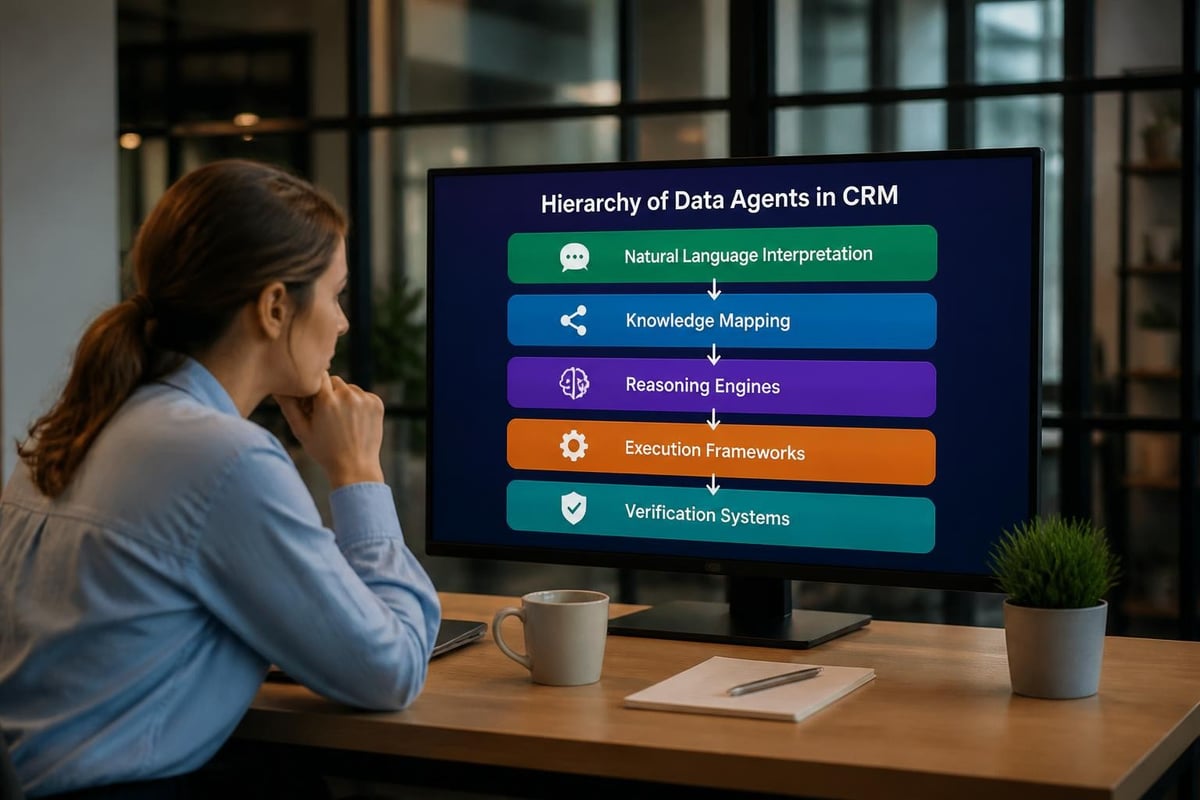
This layered approach enables data agents to handle tasks that traditionally required specialized technical knowledge. For instance, a marketing manager could ask a data agent to "identify customers who engaged with our last three campaigns but haven't converted," and the agent would autonomously query the appropriate HubSpot properties, apply relevant filters, analyze engagement patterns, and deliver a segmented list with actionable insights.
How Data Agents Differ From Traditional Automation
Traditional CRM automation relies on workflows that execute predetermined sequences when specific triggers occur. A contact submits a form, so they receive an email and get assigned to a sales rep. These workflows are powerful but fundamentally static-they do exactly what you programmed them to do, nothing more.
Data agents operate with a higher degree of autonomy and adaptability. Research on data agents identifies a hierarchical taxonomy ranging from basic query responders to fully autonomous systems capable of complex orchestration. At the foundational level, simple data agents respond to direct queries with structured outputs. Mid-tier agents can chain multiple operations together, applying logic and conditional branching. Advanced data agents function as orchestrators, managing entire data ecosystems by coordinating multiple tools, APIs, and data sources to solve complex business problems.
Traditional Automation | Data Agents |
|---|---|
Follows fixed rules and sequences | Adapts approach based on context and data |
Requires manual updates for new scenarios | Learns patterns and adjusts strategies |
Executes single-purpose workflows | Orchestrates multi-step, multi-tool processes |
Limited to predefined data paths | Dynamically queries and discovers relevant data |
Reports what happened | Analyzes why it happened and what to do next |
The distinction becomes especially relevant when dealing with data quality issues, a common challenge in CRM environments. Traditional automation might fail silently or produce incorrect results when it encounters malformed data. A data agent, conversely, can identify the inconsistency, determine the most likely correct format based on patterns in similar records, and either correct the issue autonomously or flag it for human review with specific recommendations.
Practical Applications of Data Agents in CRM Operations
The theoretical capabilities of data agents translate into tangible business value when applied to real-world CRM challenges. Organizations implementing data agents within their HubSpot environments are seeing measurable improvements across multiple operational areas.
Revenue Intelligence and Forecasting
Data agents excel at aggregating information from disparate sources to generate revenue insights that would take human analysts hours to compile. By continuously monitoring deal progression, analyzing historical win rates across different segments, and identifying patterns in sales cycles, data agents can autonomously execute data collection and transformation to produce accurate forecasts.
Rather than waiting for end-of-quarter reporting cycles, revenue teams can query their data agent in natural language: "What's our projected revenue for Q3 based on current pipeline velocity and historical close rates for similar deal compositions?" The agent analyzes relevant properties, applies statistical models, and delivers not just a number but also the supporting analysis and confidence intervals.
Customer Lifecycle Management
Managing customers across their lifecycle requires constant attention to behavioral signals, engagement patterns, and account health indicators. Data agents can monitor these elements continuously, identifying at-risk accounts before churn occurs and surfacing expansion opportunities based on usage patterns and engagement metrics.
For businesses utilizing AI and data integration strategies, data agents serve as the operational layer that turns predictive models into actionable workflows. When an agent detects declining engagement from a high-value customer, it can automatically create tasks for customer success teams, pull relevant interaction history, and even draft personalized outreach messages based on the customer's previous preferences and communication style.

Data Quality and Enrichment
Maintaining clean, complete CRM data is an ongoing challenge for most organizations. Manual data cleanup is time-consuming and rarely comprehensive. Data agents can continuously audit records, identify missing information, detect duplicates, and even source enrichment data from approved external sources.
When a new contact enters your HubSpot portal with incomplete information, a data agent can:
Analyze the available data points to determine the contact's likely role and company
Query approved data enrichment APIs for additional information
Cross-reference findings with existing records to prevent duplication
Update the contact record with verified information
Log all changes with confidence scores for audit purposes
This autonomous approach to data quality ensures that your sales and marketing teams always work with accurate, complete information without dedicating hours to manual data entry and cleanup.
Integration Capabilities and Ecosystem Management
The true power of data agents emerges when they're positioned as orchestrators within your broader technology ecosystem. Modern businesses don't operate within a single platform-they use specialized tools for marketing automation, customer service, billing, project management, and dozens of other functions.
Data agents designed for orchestrating Data+AI ecosystems can integrate knowledge comprehension, reasoning, and planning capabilities to manage complex multi-system workflows. In a HubSpot environment, this might mean a data agent that monitors deal progression in your CRM, automatically provisions new customer accounts in your product platform when deals close, creates project records in your project management system, and ensures billing information syncs correctly with your payment processor.
For organizations requiring sophisticated integration work beyond standard connectors, services like HubSpot Integrations provide the API-level customization needed to keep data flowing accurately across systems-the foundation upon which data agents can operate effectively.
Security Considerations for Data Agent Deployment
As with any AI-driven system that accesses sensitive business data, security must be a primary consideration. Research on security vulnerabilities in LLM-driven analytical systems identifies risks across interpretation, execution, and policy layers that organizations must address.
Key security measures for data agent deployment include:
Role-based access controls that limit which data sources and operations each agent can access
Audit logging that tracks every query, transformation, and action taken by agents
Human-in-the-loop checkpoints for high-stakes decisions like data deletion or financial transactions
Sandboxed execution environments that prevent agents from making unauthorized system changes
Regular validation testing to ensure agents maintain accuracy and don't develop problematic patterns
These safeguards ensure that data agents enhance operational efficiency without introducing unacceptable risk to your business data or customer information.
Implementing Data Agents Within HubSpot Environments
For businesses already invested in HubSpot, the implementation pathway for data agents varies based on specific use cases and technical infrastructure. HubSpot's native AI capabilities, including Breeze agents, provide a foundation for conversational AI and natural language querying across your CRM data.
However, sophisticated data agent implementations typically require custom development that extends beyond native platform features. The implementation process generally follows this progression:
Phase 1: Use Case Identification and Scoping
Begin by identifying specific operational pain points where autonomous data operations would deliver measurable value. Strong initial use cases typically involve repetitive analytical tasks, multi-system data synchronization, or complex reporting requirements that currently consume significant staff time.
Document the current manual process in detail, including all data sources, transformation steps, decision points, and desired outputs. This documentation becomes the specification that guides agent development.
Phase 2: Data Infrastructure Preparation
Data agents can only be as effective as the data they access. Before deploying agents, ensure your HubSpot instance has clean, well-structured data with consistent naming conventions and properly configured relationships between objects.
Preparation Area | Requirements |
|---|---|
Property standardization | Consistent field types, naming conventions, and validation rules |
Object relationships | Properly associated contacts, companies, deals, and custom objects |
Historical data cleanup | Deduplicated records, corrected inaccuracies, filled data gaps |
Permission structures | Clear access controls defining who can view and modify different data types |
Integration stability | Reliable connections to external systems the agent will access |

Phase 3: Agent Development and Training
With clean data infrastructure in place, development teams can build the agent's core functionality. This includes programming the natural language understanding layer, connecting to relevant data sources, implementing reasoning logic, and establishing validation mechanisms.
Training data agents requires providing examples of desired outcomes for various scenarios. The agent learns to recognize patterns, understand context, and select appropriate actions by processing these examples and receiving feedback on its outputs.
Phase 4: Controlled Deployment and Monitoring
Initial deployment should occur in a controlled environment where the agent handles real data but operates under close supervision. Monitor agent actions carefully, validating outputs against known correct answers and watching for unexpected behaviors.
Gradually expand the agent's responsibilities as it demonstrates consistent accuracy and appropriate decision-making. Establish clear escalation protocols for situations where the agent encounters scenarios outside its training or confidence thresholds.
Measuring Data Agent Performance and ROI
Quantifying the business impact of data agents requires tracking both operational efficiency metrics and business outcome indicators. Organizations implementing data agents effectively measure performance across multiple dimensions.
Time savings represent the most immediate and tangible benefit. Track hours previously spent on manual data tasks that the agent now handles autonomously. For many organizations, this translates to dozens of hours per week that knowledge workers can redirect toward higher-value activities.
Data quality improvements provide another measurable impact. Monitor metrics like duplicate record rates, data completeness scores, and data accuracy percentages before and after agent deployment. Improved data quality cascades into better decision-making, more effective marketing segmentation, and higher sales conversion rates.
Decision velocity measures how quickly your organization can generate insights and take action based on data. With data agents continuously monitoring relevant metrics and surfacing insights proactively, teams can respond to opportunities and risks faster than when relying on periodic manual reporting.
Revenue impact ultimately determines long-term data agent ROI. Track whether agent-driven improvements in lead routing, pipeline management, customer retention, and forecasting accuracy translate into measurable revenue growth. Building effective reports that connect data agent activities to business outcomes helps justify continued investment and expansion.
The Evolution of Data Agents and Future Capabilities
The field of data agents is advancing rapidly as underlying AI models become more capable and specialized frameworks emerge for different business domains. Current research on data agent architectures explores sophisticated hierarchical systems that can handle increasingly complex autonomous operations.
Near-term developments will likely focus on improved multi-modal capabilities, allowing data agents to process not just structured CRM data but also unstructured information like email content, call recordings, and document libraries. This expanded context awareness will enable agents to generate richer insights and make more nuanced decisions.
Advanced reasoning capabilities will allow future data agents to handle strategic planning tasks currently requiring human judgment. Rather than just reporting current pipeline status, an agent might autonomously test different territory assignments, recommend optimal pricing strategies for different customer segments, or identify entirely new market opportunities based on pattern recognition across your full data ecosystem.
Collaborative multi-agent systems represent another frontier where multiple specialized agents work together, each handling different aspects of complex workflows. One agent might focus on data quality and enrichment, another on predictive analytics, and a third on workflow orchestration-all coordinating autonomously to achieve shared objectives.
Building a Data Agent Strategy for Your Organization
Successfully implementing data agents requires more than just technical execution. Organizations must develop a comprehensive strategy that addresses cultural, operational, and governance considerations alongside the technology implementation.
Establishing Governance Frameworks
Clear governance ensures data agents operate within acceptable boundaries and maintain alignment with business objectives. Your governance framework should define:
Which data sources agents can access and under what circumstances
Decision thresholds requiring human approval versus autonomous execution
Quality standards and validation requirements for agent outputs
Escalation procedures when agents encounter uncertainty or errors
Regular review cycles to assess agent performance and adjust parameters
Building Internal Capabilities
While external partners can implement initial data agent solutions, long-term success requires developing internal expertise. Invest in training team members who can monitor agent performance, troubleshoot issues, and implement incremental improvements.
This doesn't necessarily mean hiring data scientists or AI specialists. Many effective data agent administrators come from operations or analytics backgrounds and develop technical skills through hands-on experience and targeted learning.
Balancing Autonomy and Oversight
The optimal balance between autonomous operation and human oversight varies by use case and organizational risk tolerance. High-volume, low-stakes tasks like data enrichment or basic segmentation can operate with minimal oversight. Strategic decisions with significant business impact require human review even when agents provide recommendations.
Establish clear decision-making frameworks that specify which categories of actions agents can execute independently versus which require human confirmation. This clarity prevents both excessive caution that limits agent effectiveness and insufficient oversight that introduces risk.
Data agents represent a fundamental shift in how businesses interact with their CRM systems, moving from manual data manipulation to autonomous, intelligent operations that drive better decisions and faster execution. For organizations running HubSpot, implementing data agents strategically can transform operational efficiency, improve data quality, and unlock insights that directly impact revenue growth. Revio specializes in implementing AI-driven solutions within HubSpot environments, helping businesses build the clean data infrastructure, custom integrations, and intelligent automation that enable data agents to deliver measurable business value.
One clear next move
Build the system your team needs to grow.
Tell us which tools you use, where work is breaking and what growth is asking the team to do next. We will show you the right platform, system design and level of ongoing support.
Choose the toolsConfirm the platforms and licenses your teams actually need.
Build the systemDesign the process, data, automation, integrations and reporting around the work.
Keep it growingDecide what Revio should manage after launch.