Fresh thinking for
growing businesses.
Ideas, practical guides and lessons on connecting sales, improving customer relationships and building systems that grow revenue.
Data
Data Pipeline Automation: The Complete Guide for 2026
· 8 min read
Modern businesses generate data at unprecedented volumes, but raw information means nothing without the infrastructure to process, transform, and deliver it where it matters most. Data pipeline automation has evolved from a technical luxury into a business necessity, enabling organizations to move from manual, error-prone data handling to intelligent, self-managing systems that keep revenue operations running smoothly. Companies that master automated pipelines gain competitive advantages through faster decision-making, cleaner data, and operational efficiency that manual processes simply cannot match.
Understanding Data Pipeline Automation Fundamentals
Data pipeline automation refers to the systematic process of moving data from source systems through transformation layers to final destinations without manual intervention. These pipelines continuously extract, transform, and load information while monitoring quality, handling errors, and scaling to meet demand.
The core components work together as an interconnected system. Ingestion layers pull data from CRMs, databases, APIs, and third-party platforms. Transformation engines clean, enrich, and restructure information according to business rules. Orchestration frameworks manage scheduling, dependencies, and workflow execution. Monitoring systems track pipeline health, data quality, and performance metrics.
Why Automation Matters More Than Ever
Manual data processes create bottlenecks that grow exponentially with business scale. A sales team manually exporting reports from HubSpot and uploading to spreadsheets might manage with ten deals per week, but that same process breaks down at one hundred deals. Data pipeline automation eliminates these constraints by handling repetitive tasks consistently, accurately, and at whatever volume your business requires.
The business impact extends beyond time savings. Automated pipelines reduce human error, which studies show accounts for up to 88% of data quality issues in manual processes. They provide real-time data availability instead of yesterday's numbers, enabling teams to act on current information rather than stale snapshots. Most importantly, building scalable automated pipelines frees technical resources to focus on analysis and strategy rather than data plumbing.

Building Blocks of Effective Pipeline Automation
Successful data pipeline automation requires careful attention to architecture, tooling, and operational practices. The foundation starts with understanding your data landscape and designing pipelines that align with both technical requirements and business objectives.
Source System Integration
Your pipeline's first challenge involves connecting to diverse data sources with different access patterns, formats, and update frequencies. Modern businesses typically pull from dozens of sources including CRM platforms like HubSpot, marketing automation tools, financial systems, customer support databases, and third-party enrichment services.
Integration methods vary by source type:
API connections for real-time or near-real-time data from SaaS platforms
Database replication using change data capture (CDC) for transactional systems
File-based ingestion for batch data from partners or legacy systems
Event streams for high-velocity clickstream or IoT data
Webhook listeners for push-based updates from external services
The key is selecting integration patterns that match each source's characteristics while building resilience against failures. When setting up CRM integrations, for example, proper error handling ensures pipeline continuity even when APIs experience temporary outages or rate limiting.
Transformation and Data Quality
Raw data rarely arrives in the format business systems need. Transformation layers apply business logic to convert, clean, enrich, and structure information for downstream consumption. This stage determines whether your pipeline delivers trustworthy insights or garbage that undermines decision-making.
Critical transformation patterns include:
Transformation Type | Purpose | Example Use Case |
|---|---|---|
Data cleaning | Remove duplicates, fix formatting, handle nulls | Standardizing company names across sources |
Enrichment | Add context from external sources | Appending firmographic data to contacts |
Aggregation | Summarize detailed records | Calculating monthly revenue by product line |
Normalization | Standardize values and schemas | Converting all dates to ISO 8601 format |
Business logic | Apply domain rules and calculations | Scoring leads based on engagement metrics |
Quality checks should run at every transformation step, not just at the end. Implement automated tests that validate data types, check for expected value ranges, ensure referential integrity, and flag anomalies that might indicate upstream issues. The DataOps Manifesto emphasizes treating data quality as a continuous practice rather than a one-time gate.
Orchestration and Scheduling
Orchestration engines coordinate pipeline execution by managing task dependencies, scheduling runs, handling retries, and routing data through the proper sequence of transformations. Tools like Apache Airflow define workflows as code, making pipeline logic version-controlled, testable, and reviewable.
Modern orchestration platforms provide several key capabilities. Dependency management ensures tasks execute in the correct order, with downstream processes waiting for upstream data to arrive. Scheduling flexibility supports everything from real-time streaming to monthly batch jobs. Error handling and retries automatically recover from transient failures without manual intervention. Resource optimization distributes workloads across available compute capacity.
For businesses running on Kubernetes, Argo Workflows offers native container orchestration that integrates pipeline execution directly into existing DevOps infrastructure. This approach particularly benefits organizations already invested in containerized deployments.
Implementing Data Pipeline Automation in Practice
Theory provides the framework, but practical implementation determines whether data pipeline automation delivers promised business value. Success requires balancing technical sophistication with operational pragmatism.
Choosing the Right Tools and Platforms
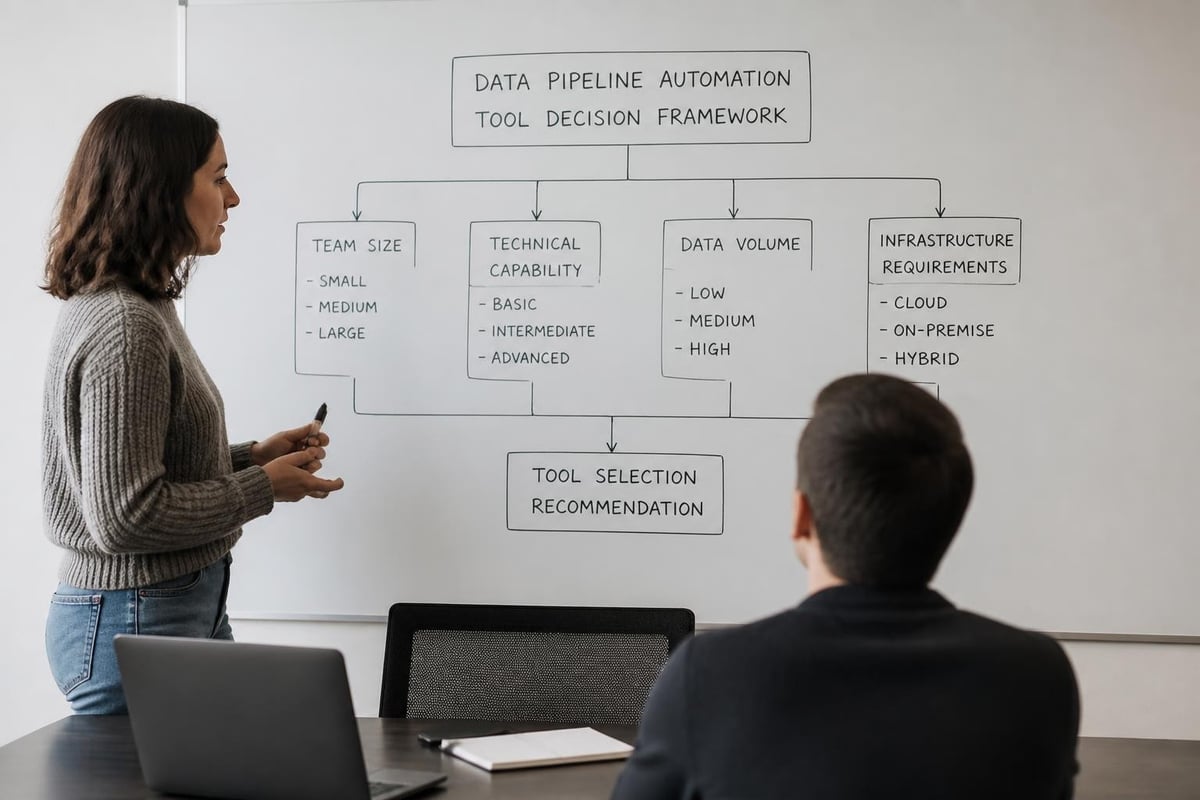
The modern data stack offers dozens of pipeline automation tools, from managed cloud services to open-source frameworks you host yourself. Your choice should align with existing infrastructure, team capabilities, and specific use cases.
Managed cloud platforms like AWS Glue or Google Cloud Dataflow handle infrastructure management, scaling, and monitoring while charging based on usage. These services excel for teams without dedicated data engineering resources or those prioritizing speed to deployment over customization.
Open-source frameworks provide maximum flexibility and control at the cost of operational overhead. You own the entire stack, from hardware to application logic, which matters for organizations with strict data governance requirements or unique processing needs that managed services cannot accommodate.
The middle ground involves hosted versions of open-source tools, where platforms like Astronomer or Prefect Cloud manage infrastructure while you retain full control over pipeline logic. This model suits teams comfortable with code-based pipeline definitions who want operational burden minimized.
Pipeline Design Patterns for Business Systems
CRM and revenue operations systems present unique pipeline requirements compared to traditional data warehousing. HubSpot implementations, for instance, need bidirectional synchronization, real-time updates, and careful handling of relationship data across objects.
Consider a typical revenue operations pipeline:
Ingest contact, company, and deal data from HubSpot via API
Enrich records with third-party firmographic and technographic data
Transform raw engagement events into scoring metrics
Calculate pipeline velocity and conversion rates by stage
Sync updated scores and insights back to HubSpot custom properties
Deliver aggregated metrics to business intelligence dashboards
Each step requires specific handling. The ingestion layer must respect API rate limits and handle HubSpot's pagination. Enrichment needs caching to avoid redundant API calls. Bidirectional sync requires conflict resolution logic when both systems modify the same record. For complex scenarios, working with experienced partners who offer HubSpot Integrations ensures these nuances are properly addressed rather than discovered through production failures.
Monitoring, Observability, and Maintenance
Automated pipelines fail in ways manual processes never could-silently, at scale, and often unnoticed until downstream systems start showing symptoms. Comprehensive monitoring catches issues before they impact business operations.
Effective data pipeline monitoring tracks multiple dimensions:
Execution metrics: Success rates, duration, resource utilization
Data quality indicators: Row counts, null rates, schema drift, distribution shifts
Business KPIs: Data freshness, completeness, accuracy against known benchmarks
Operational health: Error rates, retry counts, queue depths, system dependencies
Alert fatigue undermines even well-designed monitoring systems. Configure alerts that distinguish between informational events and actionable problems requiring immediate attention. A five-minute delay in a batch pipeline that runs nightly matters less than a failure in real-time lead routing.
Maintenance extends beyond fixing broken pipelines. Regular reviews should assess whether existing transformations still match business logic, identify optimization opportunities for growing data volumes, and update documentation as pipeline complexity evolves. Understanding how data quality impacts AI systems becomes increasingly important as organizations layer machine learning on top of automated pipelines.
Scaling Data Pipeline Automation for Growth
Small pipelines processing hundreds of records operate differently than enterprise systems handling millions of events daily. Designing for scale from the start prevents painful rewrites as data volumes grow.
Performance Optimization Strategies
Pipeline performance bottlenecks typically appear in transformation logic, external API calls, or data movement between systems. Identifying and resolving these constraints before they impact business operations requires both monitoring and proactive optimization.
Incremental processing reduces workload by processing only changed records rather than reprocessing entire datasets. Change data capture (CDC) mechanisms track modifications in source systems, triggering pipeline runs only for affected records. This approach dramatically improves efficiency for large, slowly-changing datasets like customer master records.
Parallel processing distributes work across multiple compute resources. Modern orchestration frameworks automatically partition large datasets and process segments concurrently, reducing total runtime. HubSpot pipelines benefit particularly from parallel processing when syncing thousands of contacts or companies simultaneously.
Caching and materialization store intermediate results to avoid redundant computation. If five downstream processes all need the same aggregated customer metrics, compute them once and cache the results rather than recalculating five times. Materialized views in data warehouses serve similar purposes for frequently-accessed transformations.
Continuous Integration and Deployment
Treating pipeline code like application code-with version control, testing, and automated deployment-prevents the chaos that emerges when multiple team members modify production pipelines without coordination. The principles of continuous integration and delivery for data pipelines apply regardless of platform.
Development workflows should include:
Version control for all pipeline definitions, transformations, and configuration
Automated testing validating transformation logic against sample datasets
Staging environments where pipeline changes run against production-like data before promotion
Rollback capabilities allowing quick reversion when deployments introduce issues
Change documentation explaining what changed, why, and expected impact
Testing data pipelines presents unique challenges compared to traditional software. Unit tests verify individual transformation functions work correctly. Integration tests ensure components connect properly and handle realistic data volumes. Data quality tests validate outputs meet business expectations for completeness, accuracy, and timeliness.
Metadata Management and Lineage
As pipeline ecosystems grow, understanding data lineage becomes critical for both troubleshooting and compliance. When a revenue report shows unexpected numbers, you need to trace the calculation back through transformations to source systems, identifying where logic broke or data quality degraded.
Metadata catalogs like Amundsen automatically document data assets, their schemas, transformation lineage, and business context. These systems answer questions like "which pipelines use this field?" or "where does this metric come from?" without requiring tribal knowledge from the engineer who built the original pipeline three years ago.
Proper metadata management particularly matters for pipeline reporting in revenue operations, where stakeholders need confidence in data accuracy and transparency into calculation methodologies.
Advanced Patterns and Emerging Practices
Data pipeline automation continues evolving as new technologies and methodologies emerge. Organizations that stay current with these developments gain advantages in efficiency, reliability, and capability.
Real-Time and Streaming Pipelines
Batch processing dominated data pipelines for decades, but modern business requirements increasingly demand real-time responsiveness. Streaming pipelines process events as they occur rather than waiting for scheduled batch runs.
Use cases particularly suited for streaming include:
Lead routing that assigns new inquiries to sales reps within seconds
Fraud detection identifying suspicious transactions before completion
Personalization updating customer experiences based on latest behavior
Operational monitoring triggering alerts from application or infrastructure events
Streaming architecture introduces complexity around state management, exactly-once processing guarantees, and late-arriving data. Technologies like Apache Kafka, Apache Flink, and cloud-native streaming services provide infrastructure for these patterns, but implementation requires careful design to maintain data consistency.
DataOps and Agile Pipeline Development
Traditional data pipeline development followed waterfall patterns: gather requirements, design schema, build pipeline, deploy to production. This approach fails when business needs evolve faster than development cycles.
DataOps applies agile and DevOps principles to data pipeline development, emphasizing iterative delivery, automated testing, and continuous improvement. Teams ship minimum viable pipelines quickly, gather feedback from business users, and enhance functionality through rapid iteration.
Key DataOps practices include automated testing at every pipeline stage, infrastructure-as-code for reproducible environments, self-service analytics that reduce bottlenecks on data teams, and embedded data quality monitoring throughout development. Organizations implementing these patterns typically see faster time-to-insight and higher business user satisfaction.
AI-Powered Pipeline Optimization
Machine learning increasingly augments data pipeline automation with intelligent optimization and anomaly detection. Algorithms learn normal pipeline behavior patterns and flag deviations that might indicate data quality issues, performance degradation, or upstream system changes.
Advanced implementations use reinforcement learning to automatically tune pipeline parameters like batch sizes, parallelization settings, and resource allocation based on actual performance data. These systems adapt to changing data characteristics without manual intervention, maintaining optimal performance as volumes scale.
The convergence of AI and data systems creates opportunities for smarter pipelines that self-heal, self-optimize, and provide proactive recommendations for improvement. However, this sophistication requires solid foundational practices in monitoring, metadata management, and pipeline engineering.

Common Pitfalls and How to Avoid Them
Even experienced teams encounter challenges when implementing data pipeline automation. Learning from common mistakes accelerates success and prevents costly rework.
Over-Engineering and Premature Optimization
The most sophisticated pipeline architecture means nothing if it takes six months to deliver initial value. Many teams fall into the trap of building elaborate frameworks before understanding actual requirements, resulting in complex systems that nobody uses because they solved theoretical problems rather than real business needs.
Start simple. Build a minimal pipeline that solves one specific problem, prove value, then enhance incrementally. A straightforward pipeline delivering accurate data on schedule beats a perfectly architected system still in development when the business needed answers last quarter.
Neglecting Data Quality at the Source
No amount of sophisticated transformation logic compensates for fundamentally broken source data. When common CRM mistakes create dirty data at the source, automated pipelines efficiently propagate garbage throughout your systems.
Address data quality where problems originate. Implement validation rules in HubSpot, train teams on proper data entry, establish governance processes for maintaining standards. Pipelines should clean data opportunistically but cannot substitute for source system discipline.
Insufficient Documentation and Knowledge Transfer
Pipelines built by one engineer become organizational liabilities when that person leaves and nobody understands how the system works. Inadequate documentation transforms routine maintenance into archeological expeditions through uncommented code.
Documentation should explain not just what the pipeline does but why design decisions were made. Future maintainers need context about business requirements, data quirks that drove specific handling, and assumptions baked into transformation logic. When building pipeline solutions, treat documentation as a deliverable with equal importance to the code itself.
Underestimating Operational Complexity
Data pipeline automation shifts work from manual execution to monitoring, maintenance, and enhancement. Teams sometimes assume automation means "set it and forget it," discovering too late that production pipelines require ongoing attention.
Budget for operations from the start. Plan monitoring infrastructure, establish on-call rotations, create runbooks for common issues, and allocate time for performance optimization as data volumes grow. The total cost of ownership for automated pipelines includes both initial development and ongoing operational investment.
Strategic Considerations for Business Leaders
Technical excellence in pipeline automation delivers business value only when aligned with organizational strategy and supported by appropriate resources.
Building Internal Capabilities vs. Partnering
Organizations face a fundamental choice: develop data pipeline expertise internally or engage partners who specialize in these implementations. Neither approach is universally superior-the right choice depends on your specific context.
Internal development makes sense when data engineering is core to competitive advantage, when you have unique requirements that partners cannot address, or when building institutional knowledge justifies the investment. This path requires hiring specialized talent, providing ongoing training, and accepting longer timelines for capability development.
Partner engagement accelerates time-to-value by leveraging existing expertise, proven methodologies, and battle-tested implementations. Partners bring experience across diverse industries and use cases that internal teams would take years to accumulate. For organizations where data pipelines support rather than define the business, partnership often provides better ROI.
Many successful implementations combine both approaches: partners build initial systems and transfer knowledge to internal teams who handle ongoing operations and enhancement. This hybrid model balances speed, expertise, and long-term sustainability.
Measuring Pipeline Automation ROI
Executive stakeholders rightfully demand evidence that data pipeline automation investments deliver measurable returns. Quantifying benefits requires tracking both hard cost savings and business value enablement.
Direct cost impacts include:
Labor savings from eliminated manual data tasks
Error reduction preventing costly mistakes and rework
Infrastructure efficiency through optimized resource utilization
Vendor cost avoidance by replacing multiple point solutions with integrated pipelines
Indirect value creation often exceeds direct savings:
Faster decision-making from real-time rather than stale data
New capabilities previously impossible with manual processes
Competitive advantage through insights competitors cannot access
Scalability supporting business growth without proportional headcount increases
Building revenue reporting systems that inform strategic decisions exemplifies value that transcends simple cost reduction, enabling business outcomes that justify automation investments.
Governance and Compliance Considerations
Automated pipelines handling customer data, financial records, or personally identifiable information must comply with regulatory requirements including GDPR, CCPA, SOC 2, and industry-specific standards. Automation amplifies both efficiency and risk-data breaches or compliance violations happen faster at scale.
Governance frameworks should address data access controls, audit logging, retention policies, and privacy protections. Pipelines need built-in compliance capabilities rather than bolted-on afterthoughts. Design considerations include encrypting data in transit and at rest, implementing role-based access controls, maintaining detailed audit trails, and providing mechanisms for data deletion and portability.
Data pipeline automation transforms how businesses process, analyze, and act on information, but technology alone does not guarantee success. Organizations that combine solid engineering practices, appropriate tooling, and strategic alignment achieve the full potential of automated data systems. Whether you're building your first pipeline or optimizing an existing ecosystem, partnering with specialists who understand both the technical complexities and business context accelerates results while avoiding common pitfalls. Revio helps businesses implement robust HubSpot-centered data pipelines with proper automation, quality controls, and integration architecture that grows alongside your revenue operations.
Put good ideas to work in your business.
We build practical AI systems around your customers, your team and the work that helps your business grow.