HubSpot
Deploy AI: A Strategic Guide for Business Leaders
· 11 min read
The decision to deploy AI marks a pivotal moment for organizations seeking competitive advantage through automation and intelligence. However, the journey from concept to operational AI systems involves far more than purchasing software or hiring data scientists. Successful AI deployment requires strategic planning, infrastructure readiness, organizational alignment, and a clear understanding of where artificial intelligence creates genuine business value versus where it becomes an expensive distraction.
Understanding the Foundation for AI Deployment
Before organizations can deploy AI effectively, they must establish the foundational elements that support intelligent systems. This preparation phase determines whether AI initiatives deliver measurable returns or become abandoned pilots that never reach production.
Assessing Infrastructure Readiness
Your existing technology stack plays a critical role in AI success. Many businesses discover that outdated infrastructure actively stalls AI strategy implementation, creating bottlenecks that prevent models from accessing data or scaling appropriately. Infrastructure assessment should examine:
Data storage architecture and accessibility across systems
Computing resources for training and inference workloads
API capabilities for real-time model interaction
Security protocols that protect sensitive information
Integration pathways between existing business systems
Organizations that skip infrastructure evaluation frequently encounter situations where their CRM, marketing automation, or operational systems cannot communicate with AI tools. This disconnection creates data silos that undermine the intelligence AI is supposed to provide.
Defining Clear Business Objectives
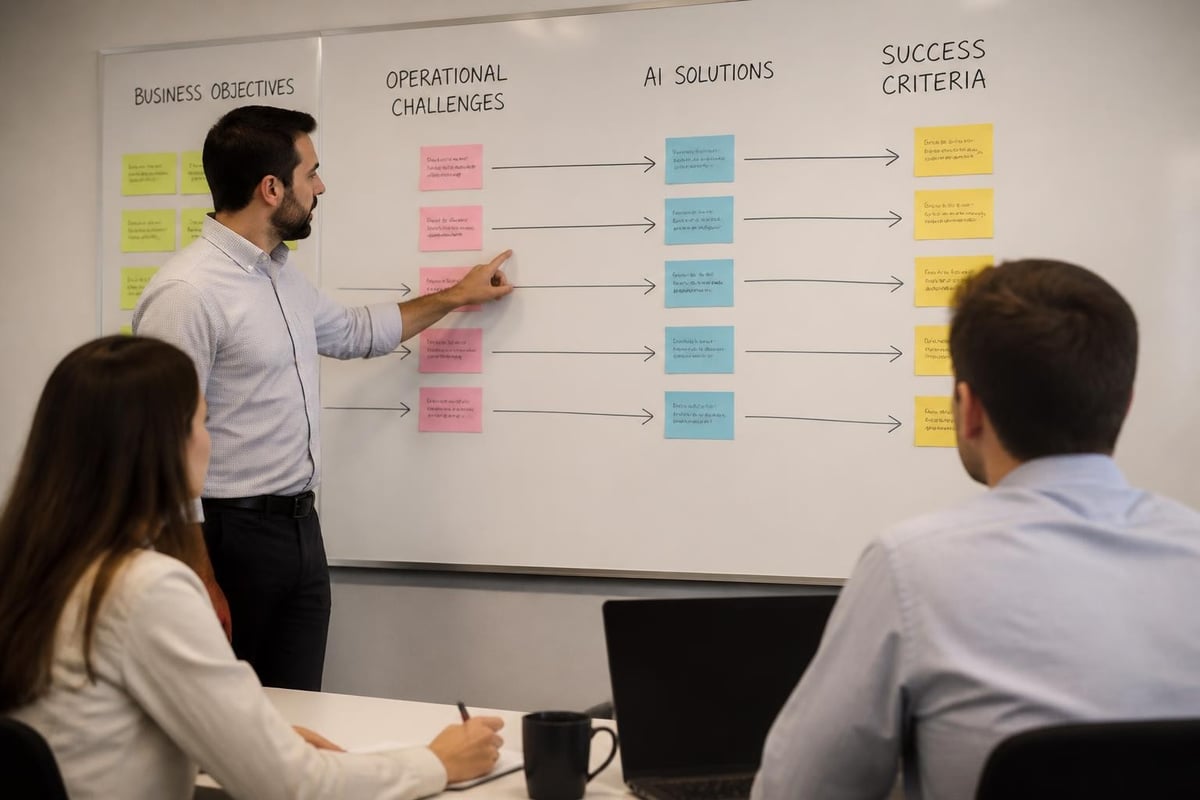
The most successful AI deployments begin with specific business problems, not technology exploration. Rather than asking "How can we use AI?" effective organizations ask "Which repetitive, data-intensive processes consume disproportionate resources?"
Business Function | AI Application | Measurable Outcome |
|---|---|---|
Sales Operations | Lead scoring and routing | Reduced response time, higher conversion rates |
Customer Service | Intent classification and triage | Decreased resolution time, improved satisfaction |
Revenue Operations | Forecast accuracy improvement | More reliable pipeline predictions |
Marketing | Content personalization | Increased engagement metrics |
When you deploy AI with clearly defined success metrics, you create accountability that prevents projects from drifting into vague "innovation initiatives" that never demonstrate ROI.
Implementing AI Within Your Technology Ecosystem
Once foundational elements are established, the implementation phase transforms strategy into operational systems. This stage requires technical precision and change management in equal measure.
Selecting the Right AI Tools and Platforms
The AI technology landscape offers overwhelming choices, from enterprise platforms to specialized point solutions. For businesses operating on HubSpot and similar CRM systems, native AI capabilities like HubSpot Breeze provide natural starting points that integrate seamlessly with existing workflows.
Evaluation criteria for AI tools should include:
Integration depth with current systems
Data requirements and availability
Training and expertise needed for operation
Scalability as usage grows
Vendor stability and support quality
Compliance with industry regulations
Organizations often achieve faster results by deploying AI tools that work within their existing ecosystem rather than introducing entirely new platforms that require extensive integration work. AI implementation inside HubSpot using native capabilities alongside specialized third-party tools allows businesses to start with familiar interfaces while gradually expanding AI sophistication.
Managing Data Quality and Governance
AI systems are only as intelligent as the data they consume. Poor data quality produces unreliable predictions, biased recommendations, and user frustration that undermines adoption. Before you deploy AI models, establish data governance practices that ensure:
Completeness: Critical fields populated consistently across records
Accuracy: Information reflects current reality, not outdated states
Consistency: Standardized formats and values across systems
Relevance: Data collected serves actual business needs
Many organizations discover that their biggest AI challenge is not the technology itself but the CRM mistakes that corrupt their data foundation. Deploying sophisticated AI on top of inconsistent, incomplete data produces sophisticated garbage.
Building Security Into AI Systems
Security cannot be an afterthought when implementing AI solutions. A four-phase security approach helps organizations protect sensitive information while enabling AI capabilities. This framework covers assessment of current security posture, policy development specific to AI use cases, technical implementation of controls, and ongoing education for teams interacting with AI systems.
Consider security implications across the AI lifecycle:
Data access controls limiting model training to appropriate information
Model protection preventing unauthorized access or manipulation
Output validation ensuring AI-generated content meets compliance standards
Audit trails documenting AI decisions for regulatory review
Privacy preservation protecting customer and employee information
Scaling AI From Pilots to Production
The gap between successful AI pilots and enterprise-wide deployment represents one of the most significant challenges organizations face. Transitioning AI projects from pilots to scalable solutions requires different thinking than initial implementation.
Addressing Common Scaling Obstacles
Pilot projects operate in controlled environments with dedicated resources and limited scope. Production AI systems must function reliably across diverse scenarios, user groups, and data conditions. Common obstacles when scaling AI include:
Obstacle | Impact | Mitigation Strategy |
|---|---|---|
Inconsistent performance across user groups | Uneven value delivery | Expanded training data representing all segments |
Infrastructure bottlenecks | Slow response times, system crashes | Capacity planning and load testing |
Change resistance | Low adoption rates | Comprehensive training and visible executive sponsorship |
Integration failures | Data synchronization issues | Robust API architecture and error handling |
Maintenance overhead | Increasing costs without value growth | Automation of model retraining and monitoring |
Organizations that successfully deploy AI at scale invest in managing AI workloads efficiently, matching infrastructure to actual requirements rather than over-provisioning or creating resource constraints.

Establishing Operational Excellence
Production AI systems require ongoing monitoring, maintenance, and optimization. Unlike traditional software that remains relatively static after deployment, AI models degrade as data patterns shift and business conditions change.
Create operational protocols for:
Performance monitoring: Track accuracy, latency, and business impact metrics
Model retraining: Schedule regular updates with fresh data
Incident response: Define procedures when AI produces unexpected results
User feedback loops: Capture insights from people interacting with AI
Version control: Manage model iterations and rollback capabilities
Teams that treat AI deployment as a one-time implementation rather than an ongoing operation quickly find their systems delivering diminishing returns. The sales processes that drive revenue growth often incorporate AI elements that require continuous refinement as customer behaviors evolve.
Learning From Real-World AI Deployments
Organizations across industries have navigated the challenges of AI implementation, providing valuable lessons for businesses beginning their deployment journey. Real-world generative AI case studies demonstrate how companies address specific challenges through thoughtful AI application.
Healthcare AI Implementation Insights
The deployment of AI in clinical settings presents unique challenges around accuracy, compliance, and integration with existing workflows. Research examining deep learning deployment in healthcare reveals that technical performance in controlled environments does not guarantee clinical utility. Successful healthcare AI deployments prioritize interpretability, allowing clinicians to understand model reasoning rather than accepting black-box recommendations.
These insights apply broadly to business AI deployments. When you deploy AI tools that affect customer relationships, revenue decisions, or operational processes, stakeholders need transparency into how the system reaches conclusions. Unexplainable AI creates trust issues that prevent adoption regardless of technical accuracy.
Responsible AI Adoption Frameworks
Moving from AI experimentation to responsible production deployment requires structured frameworks. Adopting AI responsibly involves balancing foundational preparation, implementation speed, and continuous optimization. The suggested 40-20-40 framework allocates resources to establishing solid foundations, executing deployment efficiently, and then optimizing based on real-world performance.
This balanced approach prevents two common failures: rushing deployment without adequate preparation, or endless planning that never reaches implementation. Organizations that deploy AI successfully accept that initial implementations will require refinement while ensuring core infrastructure and data quality support intelligent iteration.
AI Deployment in Resource-Constrained Environments
Not every organization possesses unlimited budgets or extensive technical teams. AI deployment research in low-resource contexts highlights strategies for implementing effective AI solutions despite constraints. Key findings include prioritizing narrow, high-impact use cases over broad AI initiatives, leveraging pre-trained models rather than building from scratch, and focusing deployment efforts where AI provides multiplicative value rather than marginal improvements.

Maximizing Business Value Through Strategic AI Application
The ultimate measure of successful AI deployment is business impact, not technical sophistication. Organizations should continuously evaluate whether their AI investments deliver measurable improvements in efficiency, revenue, or customer satisfaction.
Identifying High-Impact AI Use Cases
Certain business functions benefit disproportionately from AI enhancement. AI tools transforming sales processes demonstrate how targeted AI deployment accelerates pipeline velocity, improves forecast accuracy, and reduces administrative burden on revenue teams.
High-value AI applications typically share characteristics:
Repetitive processes performed frequently across the organization
Data-rich environments where patterns exist but manual analysis is impractical
Time-sensitive decisions where speed creates competitive advantage
Personalization requirements exceeding human capacity to customize
Prediction scenarios where historical data indicates future outcomes
When evaluating where to deploy AI, prioritize use cases meeting multiple criteria rather than spreading resources across marginal applications.
Measuring AI Performance and Business Impact
Traditional software ROI calculations do not fully capture AI value. Effective measurement frameworks track multiple dimensions:
Metric Category | Example Metrics | Business Relevance |
|---|---|---|
Efficiency Gains | Time saved per process, headcount avoided | Direct cost reduction |
Quality Improvements | Error rates, consistency scores | Risk mitigation, customer satisfaction |
Revenue Impact | Conversion rate changes, deal size variation | Top-line growth |
Strategic Capabilities | New offerings enabled, market expansion | Competitive positioning |
Organizations that deploy AI without establishing measurement frameworks struggle to justify continued investment or identify optimization opportunities. Building meaningful reports that connect AI performance to business outcomes creates visibility that sustains executive support and budget allocation.
Balancing Automation With Human Expertise
The most effective AI deployments augment human capabilities rather than attempting complete automation. Sales teams using AI lead scoring still apply judgment and relationship skills. Customer service representatives supported by AI intent classification handle complex situations that require empathy and creativity. Revenue operations professionals leverage AI forecasting while incorporating market knowledge and strategic context.
This human-AI collaboration model produces superior results while maintaining organizational flexibility. Fully automated systems become brittle when encountering scenarios outside their training data. Human oversight provides the adaptability that pure AI solutions lack.
Preparing Your Organization for Continuous AI Evolution
AI technology evolves rapidly, with new capabilities and tools emerging constantly. Organizations that deploy AI successfully in 2026 must prepare for ongoing evolution rather than viewing deployment as a finite project.
Building Internal AI Capabilities
External consultants and vendors provide valuable expertise for initial AI implementation, but long-term success requires developing internal knowledge. Investment in team development should focus on:
Technical understanding of AI capabilities and limitations
Data literacy across business functions
Prompt engineering and AI interaction skills
Critical evaluation of AI outputs and recommendations
Ethical frameworks for responsible AI use
Organizations need not transform every employee into a data scientist, but widespread AI literacy prevents misuse while encouraging innovative applications.
Staying Informed on AI Governance and Best Practices
As AI deployment expands across industries, governance frameworks and best practices continue evolving. Expert opinions on AI safety and governance inform responsible deployment strategies that balance innovation with risk management. Staying current on regulatory developments, industry standards, and emerging risks protects organizations from compliance issues and reputational damage.
Establishing internal AI governance committees that include legal, compliance, technical, and business stakeholders ensures deployment decisions consider multiple perspectives. These groups should regularly review AI use cases, assess risk levels, and update policies as technology and regulations evolve.
Planning for the Next Wave of AI Innovation
The AI landscape in 2026 differs dramatically from previous years, and the pace of change shows no signs of slowing. Organizations should maintain flexibility in their AI architecture, avoiding vendor lock-in or rigid implementations that cannot accommodate new capabilities. When you deploy AI systems with modular architectures and well-defined APIs, incorporating new tools or upgrading existing models becomes manageable rather than requiring complete reimplementation.
Forward-looking organizations allocate budget and resources for continuous AI experimentation alongside production systems. This dual-track approach maintains stable, reliable AI in production while exploring emerging capabilities that may deliver the next competitive advantage.
Successfully deploying AI requires strategic planning, infrastructure readiness, and ongoing optimization rather than one-time implementation. Organizations that approach AI deployment with clear business objectives, solid data foundations, and commitment to continuous improvement position themselves to capture genuine value from artificial intelligence. If you're ready to deploy AI within your HubSpot environment through native Breeze capabilities and integrated tools that enhance your revenue operations, Revio provides the expertise to implement AI properly, ensuring it saves your team time rather than becoming another unused technology investment.
One clear next move
Build the system your team needs to grow.
Tell us which tools you use, where work is breaking and what growth is asking the team to do next. We will show you the right platform, system design and level of ongoing support.
Choose the toolsConfirm the platforms and licenses your teams actually need.
Build the systemDesign the process, data, automation, integrations and reporting around the work.
Keep it growingDecide what Revio should manage after launch.