Fresh thinking for
growing businesses.
Ideas, practical guides and lessons on connecting sales, improving customer relationships and building systems that grow revenue.
HubSpot
AI Pipeline: Building Intelligent Automation for CRMs
· 4 min read
Artificial intelligence has evolved from experimental technology to essential infrastructure for modern businesses. An ai pipeline represents the systematic flow of data through multiple stages of processing, transformation, and intelligence, ultimately delivering automated decisions and insights that drive business outcomes. For companies leveraging CRM platforms like HubSpot, understanding how to architect and implement ai pipelines has become critical for competitive advantage. These pipelines integrate machine learning models, data processing workflows, and business logic to create intelligent systems that enhance everything from lead scoring to revenue forecasting.
Understanding AI Pipeline Architecture
An ai pipeline consists of interconnected components that work together to transform raw data into actionable intelligence. The architecture typically includes data ingestion, preprocessing, feature engineering, model training, validation, deployment, and monitoring phases that execute in sequence or parallel depending on business requirements.
Core Components of Production AI Systems
Every production-ready ai pipeline requires several fundamental building blocks that ensure reliability and performance. The data layer handles ingestion from multiple sources, including CRM records, third-party integrations, website activity, and external enrichment APIs. This layer must accommodate both batch processing for historical analysis and real-time streaming for immediate decision-making.
The processing and transformation stage cleanses, normalizes, and enriches raw data to prepare it for model consumption. This involves:
Deduplication and data quality validation
Schema mapping and field standardization
Feature extraction from unstructured content
Time-series aggregation for behavioral patterns
Data augmentation from external sources
The modeling layer contains the actual AI components, whether traditional machine learning algorithms, deep learning networks, or large language models. Modern ai pipeline architectures often combine multiple model types to address different business problems within a single workflow.

Orchestration and Workflow Management
Coordinating the various stages of an ai pipeline requires robust orchestration tooling that manages dependencies, schedules, and failure recovery. Apache Airflow provides proven patterns for orchestrating MLOps workflows, enabling teams to define complex data and model dependencies as code while maintaining visibility into pipeline execution.
The orchestration layer tracks data lineage, manages computational resources, and ensures that downstream stages only execute when upstream dependencies complete successfully. This becomes particularly important in CRM environments where data freshness directly impacts sales and marketing effectiveness.
Orchestration Feature | Business Value | Implementation Complexity |
|---|---|---|
Scheduled execution | Predictable data refresh cycles | Low |
Dynamic task generation | Adaptive processing based on data volume | Medium |
Failure recovery & retry | Resilience against temporary outages | Medium |
Resource optimization | Cost control for cloud compute | High |
Cross-system coordination | Integration with CRM, data warehouse, APIs | High |
Implementing AI Pipelines in CRM Environments
CRM platforms present unique opportunities and constraints for ai pipeline implementation. Unlike pure data science environments, CRM-based pipelines must balance analytical sophistication with operational simplicity, ensuring that sales and marketing teams can trust and act on AI-generated insights.
Data Sources and Integration Patterns
The foundation of any CRM ai pipeline starts with comprehensive data access across the customer lifecycle. Contact properties, company attributes, deal stages, email engagement, website behavior, and support interactions all contribute signals that improve model accuracy.
Integration architecture determines pipeline flexibility. Native CRM APIs provide reliable access to structured data, while webhooks enable real-time event triggering for immediate AI processing. For HubSpot specifically, the combination of Operations Hub workflows, custom coded actions, and bidirectional API integrations creates a robust foundation for AI automation services that enhance existing business processes.
Many organizations underestimate the complexity of maintaining data quality across integrated systems. Common CRM mistakes often stem from poor data governance, which directly degrades ai pipeline performance. A contact record with inconsistent industry classifications or missing engagement history limits model effectiveness regardless of algorithm sophistication.
Feature Engineering for Business Outcomes
The features fed into AI models determine their predictive power more than algorithm selection. In CRM contexts, effective feature engineering translates business knowledge into quantifiable signals that models can process.
Temporal features capture behavioral patterns over time:
Engagement velocity measures the rate of contact interactions increasing or decreasing
Deal progression speed tracks how quickly opportunities move through pipeline stages
Response latency quantifies time gaps between touchpoints
Activity recency weights recent behaviors more heavily than historical patterns
Relational features exploit the network structure of business relationships. Company hierarchies, contact roles, previous customer relationships, and industry peer behaviors all provide context that improves prediction accuracy beyond individual record attributes alone.
Model Training and Validation Strategies
An effective ai pipeline implements rigorous validation to ensure models generalize beyond training data. For CRM applications, this requires time-based splitting that respects the temporal nature of sales and marketing processes. Training on historical data and validating against recent performance prevents data leakage and produces realistic accuracy estimates.
The challenge of class imbalance appears frequently in CRM scenarios. Won deals typically represent a small percentage of total opportunities, creating severe imbalance that naive models handle poorly. Techniques like synthetic minority oversampling, class weighting, and threshold adjustment help ai pipelines produce useful predictions despite imbalanced distributions.
TensorFlow Extended provides comprehensive frameworks for building production ML pipelines that address these validation challenges through components dedicated to data validation, transform consistency, and model analysis before deployment.
Deployment and Production Operations
Moving an ai pipeline from development to production introduces operational complexity that many organizations underestimate. The deployment phase requires careful attention to performance, monitoring, and maintenance to ensure sustained business value.
Inference Architecture Patterns
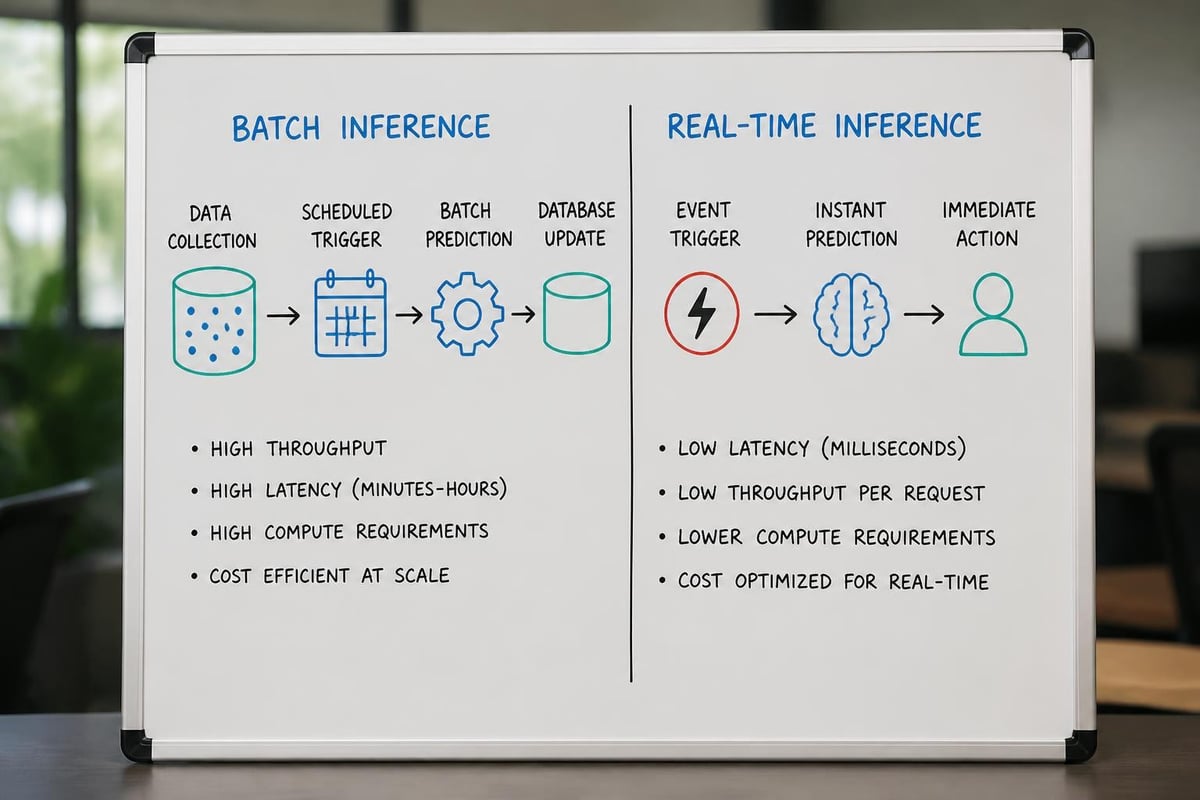
Production ai pipelines support two primary inference patterns, each suited to different business requirements. Batch inference processes large volumes of records on a schedule, updating scores and predictions for the entire database periodically. This approach works well for lead scoring, account prioritization, and forecasting where near-real-time updates provide minimal additional value.
Real-time inference generates predictions on-demand as individual events occur, enabling immediate automated actions like intelligent routing, dynamic content personalization, and conversational AI. The latency requirements are strict, typically demanding responses within milliseconds to maintain user experience quality.
Hybrid architectures combine both patterns to optimize for cost and performance. Heavy computation runs in batch mode to precompute features and scores, while lightweight real-time models consume those precomputed values to make instant decisions without repeating expensive calculations.
Model Monitoring and Drift Detection
AI models degrade over time as business conditions, customer behaviors, and market dynamics shift. An ai pipeline without robust monitoring inevitably produces increasingly inaccurate predictions as the gap between training data and current reality widens.
Statistical monitoring tracks prediction distributions, feature statistics, and performance metrics to detect drift before it significantly impacts business outcomes. Google Cloud's Vertex AI model monitoring provides comprehensive drift detection capabilities that alert teams when model behavior changes meaningfully.
Performance monitoring measures business metrics like conversion rates, revenue impact, and user satisfaction alongside traditional ML metrics such as precision and recall. A model with stable technical metrics but declining business performance indicates that optimizing for the wrong objective function or that market conditions have shifted in ways the model cannot capture.
Monitoring Dimension | Key Metrics | Alert Threshold |
|---|---|---|
Data quality | Missing values, outliers, schema violations | >5% degradation |
Feature drift | Distribution shifts, correlation changes | >10% statistical divergence |
Prediction drift | Output distribution changes | >15% shift from baseline |
Performance decay | Business KPI degradation | >8% decline from expected |
System health | Latency, throughput, error rates | SLA violations |
Advanced Pipeline Capabilities
Modern ai pipeline implementations extend beyond basic prediction to incorporate sophisticated capabilities that address complex business requirements and enable new use cases.
Multi-Model Orchestration
Business problems rarely map cleanly to single model architectures. Effective ai pipelines combine multiple specialized models, each optimized for specific subtasks, into cohesive systems that deliver comprehensive intelligence.
For CRM lead management, this might involve:
NLP models for extracting intent from email and form submissions
Classification models for industry and company size categorization
Regression models for deal value prediction
Time-series models for conversion timeline forecasting
Recommendation engines for next-best-action suggestions
The orchestration layer coordinates these models, managing their interdependencies and combining their outputs into unified recommendations. Kubeflow Pipelines provides proven patterns for defining these complex multi-model workflows in cloud-native environments.
Feature Stores and Reusability
As organizations scale their AI initiatives across multiple use cases, feature engineering becomes duplicative and inconsistent without centralized infrastructure. Feature stores solve this by creating a shared repository of curated, versioned features that multiple ai pipelines can consume.
The offline store contains historical feature values used for model training and batch inference. The online store maintains current feature values optimized for low-latency real-time inference. Feast documentation describes these architectural patterns in detail, explaining how to maintain consistency between training and serving environments.
In CRM contexts, a feature store might centralize calculations like customer lifetime value, engagement scores, product affinity metrics, and behavioral segments. This ensures that the lead scoring model, the forecasting model, and the recommendation engine all use identical feature definitions, preventing inconsistencies that erode user trust.
Continuous Training and AutoML
Static models trained once and deployed indefinitely provide diminishing value as time passes. Continuous training ai pipelines automatically retrain models on fresh data according to defined schedules or performance triggers, ensuring predictions stay current with evolving patterns.
AutoML capabilities further reduce maintenance burden by automating hyperparameter tuning, feature selection, and algorithm comparison. While not appropriate for all scenarios, AutoML excels at standardized prediction tasks where domain expertise provides limited advantage over automated optimization.
MLflow provides tooling for reproducible ML pipelines that support both manual and automated retraining workflows, tracking experiments, parameters, and metrics across model iterations to maintain visibility into model evolution.
Enterprise AI Pipeline Considerations
Organizations implementing ai pipelines at scale encounter governance, security, and integration challenges that require thoughtful architectural decisions and process design.
Data Governance and Privacy
CRM data contains personally identifiable information subject to regulations like GDPR and CCPA. An ai pipeline must implement appropriate safeguards including data minimization, consent tracking, anonymization for non-production environments, and audit logging for regulatory compliance.
Access controls ensure that data scientists and ML engineers only access data necessary for their specific responsibilities. Role-based permissions, data masking, and secure enclaves prevent unauthorized exposure of sensitive customer information during model development and debugging.
AWS prescriptive guidance on MLOps planning addresses these governance concerns in enterprise contexts, providing frameworks for balancing innovation with compliance requirements.
Version Control and Reproducibility
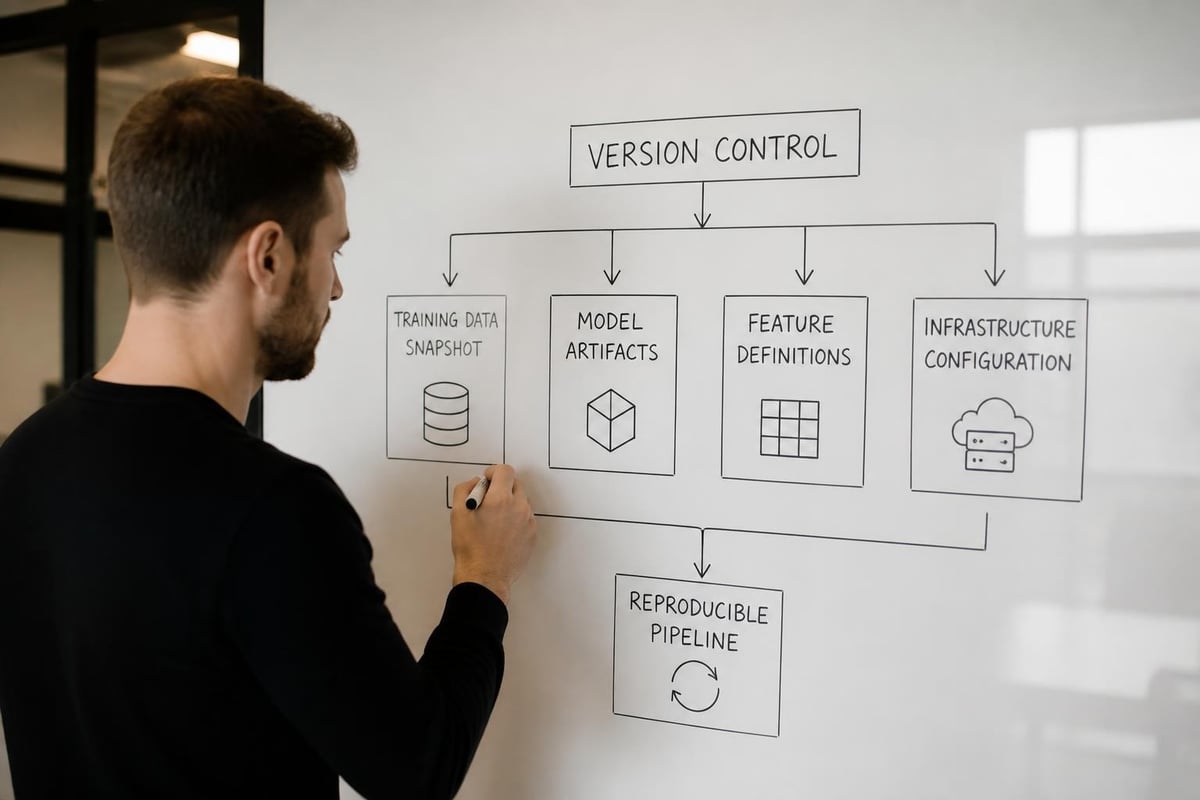
Production ai pipelines require rigorous version control covering code, data, models, and infrastructure configurations. Without comprehensive versioning, diagnosing production issues, rolling back problematic deployments, and reproducing historical results becomes impossible.
Data versioning captures snapshots of training datasets, enabling exact replication of model training runs. Model versioning tracks trained artifacts with their associated code, hyperparameters, and performance metrics. Infrastructure versioning uses tools like Terraform to define computational environments as code.
This multi-dimensional versioning creates full reproducibility, allowing teams to recreate any production model exactly as it was trained and deployed, even months or years later when investigating unexpected behaviors or regulatory inquiries.
Integration with Business Processes
Technical sophistication means little if ai pipeline outputs fail to integrate seamlessly with existing business workflows. For CRM implementations, this requires bidirectional integration where AI enriches CRM data and business users provide feedback that improves model accuracy.
The AI Implementation services approach focuses on identifying specific workflow pain points where AI provides measurable value rather than implementing technology for its own sake. Lead routing automation, content generation, data enrichment, and conversational interfaces represent high-value integration points where ai pipelines deliver immediate returns.
User interfaces determine adoption rates more than model accuracy in many cases. Sales teams ignore perfect predictions presented poorly, but embrace good-enough predictions delivered contextually within their existing workflows. This argues for investing substantial effort in the "last mile" of ai pipeline implementation where model outputs surface in CRM interfaces.
AI Pipeline Performance Optimization
As ai pipelines mature, optimization becomes necessary to control costs, improve latency, and scale to increasing data volumes without proportional infrastructure expansion.
Computational Efficiency
Training and inference costs scale with data volume and model complexity. Optimization strategies include:
Model compression through quantization, pruning, and knowledge distillation
Feature selection to eliminate low-value inputs that add minimal predictive power
Caching to avoid repeated computation of expensive features
Batch processing to amortize fixed costs across multiple predictions
Hardware acceleration using GPUs or specialized ML chips for compute-intensive operations
The optimal strategy depends on bottleneck location. CPU-bound pipelines benefit from parallelization and distributed processing, while memory-bound pipelines require streaming architectures that process data incrementally without loading entire datasets.
Data Pipeline Optimization
Data movement often dominates ai pipeline execution time more than actual model computation. Minimizing data transfer through strategic placement, compression, and incremental processing significantly improves end-to-end performance.
Partitioning large datasets by logical boundaries like time ranges or customer segments enables parallel processing and incremental updates that only reprocess changed partitions. This proves particularly valuable in CRM contexts where most records remain static while a small percentage change daily.
Column-oriented storage formats like Parquet dramatically improve performance for analytical workloads that access subsets of fields across many records. Converting raw CRM exports into optimized storage formats during ingestion pays dividends throughout the ai pipeline lifecycle.
Monitoring and Alerting Infrastructure
Production ai pipelines require comprehensive observability to maintain reliability and performance. Monitoring infrastructure tracks technical metrics (latency, throughput, error rates) alongside business metrics (prediction accuracy, user adoption, revenue impact) to provide holistic visibility.
Alert design requires careful threshold tuning to avoid both false positives that create alarm fatigue and false negatives that allow silent failures. Progressive alert severity from warnings to critical incidents enables appropriate response without overwhelming on-call teams.
Microsoft's MLOps architecture guidance describes comprehensive monitoring patterns for production ML systems, including infrastructure health, data quality, model performance, and business impact dimensions.
Future Evolution of AI Pipelines
The ai pipeline landscape continues evolving rapidly as new technologies, architectural patterns, and business requirements emerge. Understanding these trends helps organizations make forward-looking implementation decisions that remain relevant as the field advances.
Large Language Models and Generative AI
The emergence of capable large language models fundamentally changes ai pipeline architecture by enabling new capabilities while introducing new challenges. LLMs excel at unstructured data processing, content generation, and reasoning tasks that previously required specialized models and extensive feature engineering.
Pipeline integration patterns for LLMs differ from traditional ML models. Prompt engineering replaces feature engineering as the primary tuning mechanism. Context window management and token optimization become critical performance factors. Output validation and hallucination detection require new testing approaches that traditional classification metrics cannot address.
Hybrid architectures that combine LLMs for reasoning and content with traditional ML for structured prediction represent an emerging best practice. The LLM handles natural language understanding and generation while purpose-built models deliver precise numerical predictions based on structured features.
Edge Deployment and Federated Learning
Privacy regulations and latency requirements increasingly drive ai pipeline deployment to edge locations closer to data sources. This distributed architecture enables real-time inference without central data aggregation, addressing both performance and compliance concerns.
Federated learning extends this pattern to model training, allowing ai pipelines to learn from distributed data without centralizing sensitive information. Models train locally on device or regional data, sharing only model updates rather than raw data to a central aggregator that produces a global model.
For CRM applications, federated approaches could enable learning from customer interaction patterns across multiple geographic regions while respecting data residency requirements that prohibit cross-border transfer.
AutoML and Low-Code AI Platforms
The barrier to ai pipeline implementation continues falling as AutoML platforms and low-code tools democratize access to machine learning capabilities. These platforms automate feature engineering, model selection, hyperparameter tuning, and deployment, reducing the specialized expertise required for production AI systems.
While AutoML excels at standardized prediction tasks, complex business problems still benefit from expert data science work. The emerging pattern combines AutoML for rapid prototyping and commodity use cases with custom development for strategic differentiation and complex requirements.
Research on MLOps architectures reveals increasing convergence toward standardized patterns and tooling that reduce implementation complexity while maintaining flexibility for advanced use cases.
Building effective ai pipelines requires balancing technical sophistication with practical business value, ensuring that powerful ML capabilities translate into measurable improvements in CRM performance and revenue outcomes. The architecture, integration, and operational practices described throughout this guide provide a foundation for implementing intelligent automation that scales with business growth. Whether you're implementing your first lead scoring model or architecting comprehensive revenue intelligence systems, Revio brings specialized expertise in HubSpot AI integrations and pipeline automation to help you deploy production-ready ai pipelines that drive efficient growth.
Put good ideas to work in your business.
We build practical AI systems around your customers, your team and the work that helps your business grow.