HubSpot
AI Reporting: Transform Business Intelligence in 2026
· 5 min read
Artificial intelligence has fundamentally changed how organizations generate, analyze, and act on business intelligence. What once required days of manual data compilation and spreadsheet manipulation now happens in minutes through intelligent automation. AI reporting combines machine learning algorithms with traditional business intelligence frameworks to deliver faster, more accurate, and predictive insights that drive revenue growth. For companies leveraging platforms like HubSpot, integrating AI into reporting workflows creates a competitive advantage that extends far beyond simple dashboard generation.
Understanding the Evolution of AI Reporting
Business reporting has undergone three distinct phases over the past two decades. Initially, organizations relied on manual data extraction and static reports delivered on fixed schedules. The second phase introduced automated dashboards that refreshed regularly but still required human interpretation. We've now entered the third phase where AI reporting actively analyzes patterns, predicts outcomes, and generates narrative insights without constant human oversight.
Modern ai reporting systems process structured and unstructured data simultaneously. They pull information from CRM platforms, marketing automation tools, financial systems, and customer support databases to create unified intelligence. The algorithms identify correlations that human analysts might miss, particularly when dealing with datasets containing thousands of customer interactions across multiple touchpoints.
Key Components of AI-Driven Intelligence
The foundation of effective AI reporting rests on several technical pillars that work in concert:
Natural language generation converts numerical data into written summaries and explanations
Predictive analytics forecast future performance based on historical patterns
Anomaly detection flags unusual trends or data points requiring immediate attention
Automated data cleaning identifies and corrects inconsistencies before they corrupt reports
Real-time processing enables continuous monitoring rather than periodic snapshots
These capabilities transform reporting from a backward-looking exercise into a forward-focused strategic tool. Organizations using platforms like HubSpot can integrate AI implementation to enhance their existing workflows without replacing entire systems.

Practical Applications Across Business Functions
AI reporting delivers value across every department, though implementation priorities vary based on organizational needs and data maturity. Sales teams use predictive deal scoring to identify which opportunities deserve immediate attention. Marketing departments analyze campaign performance across channels to optimize budget allocation in real time. Finance teams automate variance analysis and cash flow forecasting with greater accuracy than manual methods ever achieved.
Revenue Operations and Pipeline Intelligence
Revenue operations teams benefit significantly from ai reporting capabilities. Traditional pipeline reports show deal stages and values but require analysts to interpret velocity, conversion rates, and risk factors manually. AI systems automatically calculate these metrics and highlight deals that are stalling, advancing faster than expected, or showing characteristics associated with closed-lost opportunities.
Consider a scenario where 200 deals sit in various pipeline stages. Manual review might catch five that need attention. AI reporting scans all 200, applies pattern recognition from thousands of historical deals, and identifies 18 opportunities requiring intervention based on engagement patterns, stakeholder behavior, and timeline drift. This precision directly impacts pipeline reporting accuracy and revenue predictability.
Traditional Reporting | AI Reporting |
|---|---|
Weekly manual review | Continuous monitoring |
Backward-looking metrics | Predictive scoring |
Generic benchmarks | Company-specific patterns |
Manager interpretation required | Automated insight generation |
Static thresholds | Dynamic adjustment |
Building Trust Through Accuracy and Transparency
The adoption of AI in business intelligence faces skepticism similar to what journalists experience when using automated tools. According to research on AI adoption among UK journalists, trust issues center on verification, attribution, and the potential for algorithmic bias. Business leaders face parallel concerns when implementing ai reporting systems.
Establishing confidence requires transparent methodology. Organizations should document how AI models are trained, what data sources feed them, and how predictions are calculated. This documentation serves the same purpose as the Associated Press standards on generative AI in journalism, creating accountability frameworks that prevent blind reliance on automated outputs.
Validation Frameworks for Automated Insights
Smart organizations implement validation layers rather than accepting AI outputs at face value. These frameworks typically include:
Benchmarking against known results to verify accuracy during implementation
Human review of anomalies before taking action on unexpected findings
Regular audits of data quality feeding into AI models
Comparison with external market data to contextualize internal metrics
Documentation of false positives to refine algorithms over time
The NIST framework for evaluating machine-generated reports provides methodological guidance for assessing reliability. Applying similar rigor to business intelligence prevents the costly mistakes that occur when flawed data or mistuned algorithms drive strategic decisions.
Integration with Existing Technology Stacks
Most organizations already operate business intelligence platforms, CRM systems, and data warehouses. Successful AI reporting implementations connect to these existing tools rather than requiring complete replacement. HubSpot users, for example, can extend native reporting with AI layers that enhance rather than disrupt current workflows.
The integration architecture typically follows this pattern: existing systems continue capturing transactional data, a middleware layer normalizes and enriches that information, and AI engines process the cleaned data to generate insights. Results flow back into familiar dashboards where teams already work, minimizing adoption friction.

API-Level Connections and Data Synchronization
Surface-level integrations using native connectors often lack the depth required for sophisticated ai reporting. Advanced integration work enables bidirectional data flow, custom field mapping, and real-time synchronization that basic tools cannot deliver. These technical foundations ensure AI models work with complete, current information rather than stale snapshots.
Organizations frequently underestimate the data cleanup required before AI can deliver value. CRM databases filled with duplicate records, incomplete fields, and inconsistent formatting produce unreliable insights regardless of how sophisticated the AI model might be. Addressing data quality fundamentals becomes a prerequisite for successful AI reporting implementation.
Designing Dashboards That Drive Action
AI-generated insights lose value if they sit in reports nobody reads or understands. Dashboard design must translate complex analytics into clear visualizations that prompt specific actions. The best implementations segment information by role, delivering sales managers different views than CFOs or marketing directors receive.
Effective AI reporting dashboards share common characteristics:
Role-specific filtering shows only metrics relevant to each user's responsibilities
Exception-based alerts draw attention to outliers rather than displaying everything
Trend visualization makes directional changes obvious at a glance
Drill-down capability allows investigation without leaving the interface
Recommended actions suggest next steps based on what the data reveals
Consider how revenue reporting dashboards might present AI insights. Rather than showing every deal and metric, the system highlights the three deals most likely to close this week, the two territories underperforming projections, and the one product line showing unexpected momentum. Each insight links to supporting data and suggests specific interventions.
Ethical Considerations and Bias Management
Just as media organizations grapple with AI's role in journalism, businesses must address ethical questions around automated decision-making. The World Economic Forum's principles for responsible media in the AI era emphasize transparency, accountability, and human oversight-principles equally applicable to business intelligence.
AI reporting systems can perpetuate historical biases present in training data. If past hiring patterns favored certain demographics, AI analyzing employee performance might reinforce those patterns. If sales territories were historically allocated based on subjective criteria, algorithms might encode those biases into future recommendations. Responsible implementation requires conscious effort to identify and correct these issues.
Building Governance Frameworks
Organizations should establish governance committees that review AI reporting systems regularly. These groups, comprising technical experts and business stakeholders, assess whether automated insights align with company values and strategic objectives. They also monitor for unintended consequences that emerge only after systems operate at scale.
Documentation practices borrowed from journalistic standards prove useful here. The Poynter AI ethics guidelines recommend disclosure of AI involvement, verification procedures, and correction protocols. Business contexts might adapt these as policies requiring human review before major resource allocations based on AI recommendations, or mandatory documentation when overriding algorithmic suggestions.
Measuring ROI and Business Impact
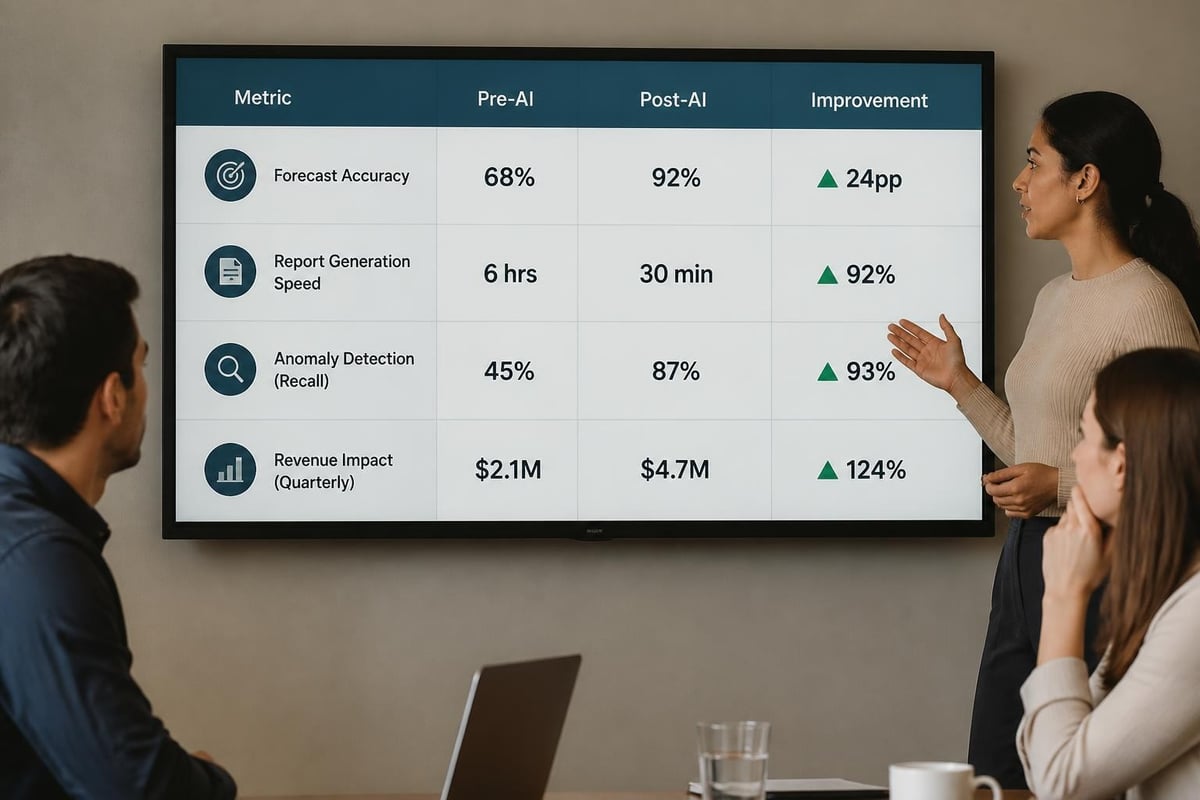
Executives demand clear evidence that AI reporting investments deliver measurable returns. Unlike simple automation that reduces headcount, AI reporting's value manifests through better decisions, faster response times, and improved forecast accuracy. Quantifying these benefits requires establishing baselines before implementation and tracking specific metrics afterward.
Success Metric | Baseline Measurement | Target Improvement |
|---|---|---|
Forecast accuracy | ±15% variance | ±5% variance |
Report generation time | 8 hours weekly | 30 minutes weekly |
Anomaly detection rate | 40% of issues caught | 85% of issues caught |
Time to insight | 3-5 days | Real-time |
Decision cycle speed | Weekly reviews | Daily adjustments |
Revenue impact provides the most compelling ROI evidence. Track whether win rates improve after implementing predictive deal scoring. Measure whether marketing spend efficiency increases following AI-driven budget recommendations. Quantify how much faster sales cycles move when AI identifies and surfaces hot prospects automatically.
Training Teams for AI-Enhanced Workflows
Technology adoption fails when users don't understand how to interpret or act on new capabilities. AI reporting requires different skills than traditional business intelligence. Teams need training in questioning algorithmic recommendations, understanding confidence intervals, and recognizing when human judgment should override automated suggestions.
Effective training programs address three competency levels:
Basic users learn to read AI-generated reports and understand confidence scores
Power users master dashboard customization and alert configuration
Administrators gain skills in model tuning and data governance
This tiered approach prevents overwhelming frontline staff while building internal expertise for system management. Organizations should also establish feedback loops where users report confusing outputs or incorrect predictions, enabling continuous refinement.
Future Developments Shaping the Landscape
The trajectory of AI reporting points toward increasingly autonomous systems that not only analyze data but also execute responses. Current implementations identify opportunities and flag risks. Next-generation platforms will automatically adjust marketing budgets, reassign leads, or trigger customer outreach based on detected patterns-all with appropriate human oversight gates.
Natural language interfaces will replace dashboard navigation for many use cases. Instead of building complex filtered views, users will simply ask questions in plain English: "Which customers are at risk of churning?" or "What's driving the conversion rate drop in our northeast region?" The AI interprets intent, analyzes relevant data, and delivers narrative answers with supporting visualizations.
Public perception research, like studies on generative AI's role in journalism and society, reveals growing comfort with AI-assisted information when transparency and accuracy standards are maintained. Business users will likely follow similar acceptance curves as systems prove their reliability through consistent performance.
Implementation Roadmap for Success
Organizations embarking on AI reporting journeys should follow a phased approach rather than attempting enterprise-wide transformation simultaneously. Start with a single department or use case where data quality is strong and business impact is easily measured. Early wins build organizational confidence and provide learning opportunities before broader rollout.
Phase One focuses on data foundation and pilot selection. Audit current reporting processes, identify pain points, clean critical datasets, and choose one high-value use case for initial implementation. This phase typically spans 6-8 weeks and requires minimal AI tooling investment.
Phase Two implements the pilot, integrating AI capabilities with existing workflows. Configure dashboards, train users, establish feedback mechanisms, and document results. Expect this phase to require 8-12 weeks as teams adapt to new capabilities and refine configurations.
Phase Three expands successful patterns to additional departments and use cases. Each expansion builds on lessons learned, leveraging proven frameworks while customizing for specific needs. Organizations typically reach enterprise-scale deployment 6-12 months after initial pilot launch.
Throughout implementation, maintain focus on solving real business problems rather than deploying technology for its own sake. The most successful ai reporting initiatives start with questions like "How can we predict customer churn more accurately?" rather than "What can we do with this new AI tool?"
AI reporting represents a fundamental shift in how businesses generate and use intelligence to drive growth. By combining machine learning with established business intelligence practices, organizations gain predictive capabilities, real-time insights, and automated analysis that were impossible just a few years ago. Success requires clean data foundations, thoughtful integration, transparent methodology, and ongoing refinement as business needs evolve. Revio helps companies implement AI reporting within HubSpot environments, building the technical foundations and operational frameworks that turn raw data into revenue-driving intelligence through expert configuration and strategic guidance.
One clear next move
Build the system your team needs to grow.
Tell us which tools you use, where work is breaking and what growth is asking the team to do next. We will show you the right platform, system design and level of ongoing support.
Choose the toolsConfirm the platforms and licenses your teams actually need.
Build the systemDesign the process, data, automation, integrations and reporting around the work.
Keep it growingDecide what Revio should manage after launch.